




Current review snapshot: 50 published client request reviews
Review dates represented: 30 May to 25 August 2026
Last updated: 28 August 2026
What happens after someone posts a wedding request and waits for vendors to respond?
That question is more useful than asking whether a wedding marketplace simply has many listings. Couples do not experience a platform as a database. They experience it as a sequence: explain what they need, receive responses, judge whether those responses are relevant, compare prices and portfolios, and decide whom they can trust with an important event.
The client request reviews on Marriage In Nigeria make that sequence visible. Some requesters describe fast outreach, useful alternatives, helpful professionals and vendors who eventually delivered. Others describe the opposite: unsuitable locations, no clear match, prices outside their budgets, unclear next steps or uncertainty about verification.
Taken together, the feedback presents a more valuable story than a page of testimonials. It shows where the request marketplace is already creating practical value, where contact fails to become a suitable match, and what couples, vendors and Marriage In Nigeria can do to improve the experience.
The clearest finding: Marriage In Nigeria is helping many requesters move from searching to real vendor conversations and selections. The biggest constraint is not contact alone. It is match quality across four filters: location, service relevance, budget and trust.
What the Current Reviews Say at a Glance
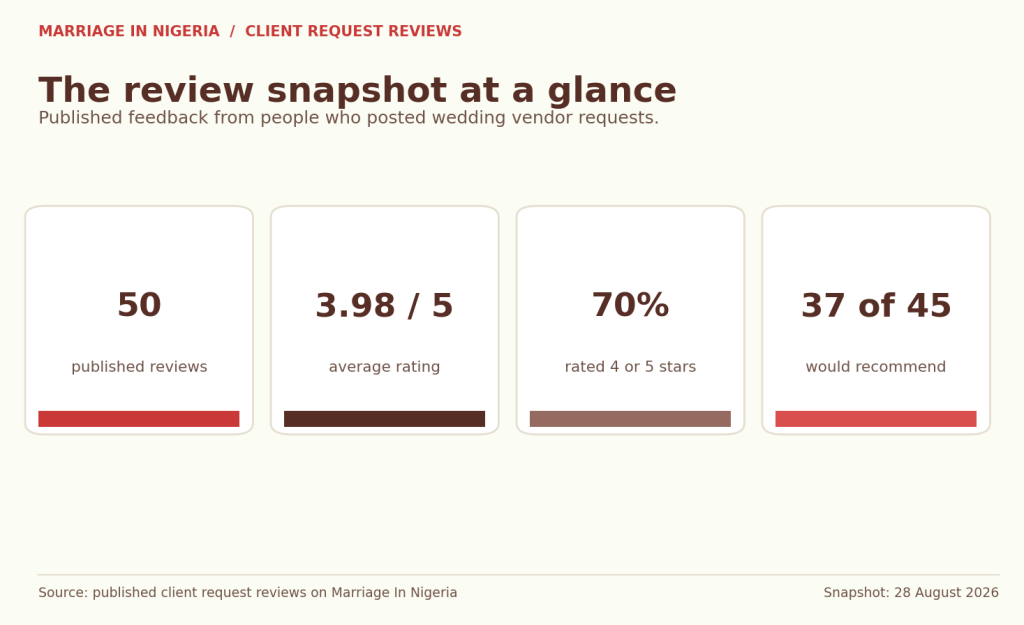
- 50 published client request reviews are included in this edition.
- The average rating is 3.98 out of 5, while the median is 4 out of 5.
- 35 reviewers – 70% – gave four or five stars.
- 21 reviewers – 42% – gave the full five stars.
- 15 reviewers – 30% – gave three stars or fewer, so the positive average should not obscure mixed and negative experiences.
- 45 reviewers answered the recommendation question. Of those, 37 – 82.2% – said yes, six were unsure and two said no.
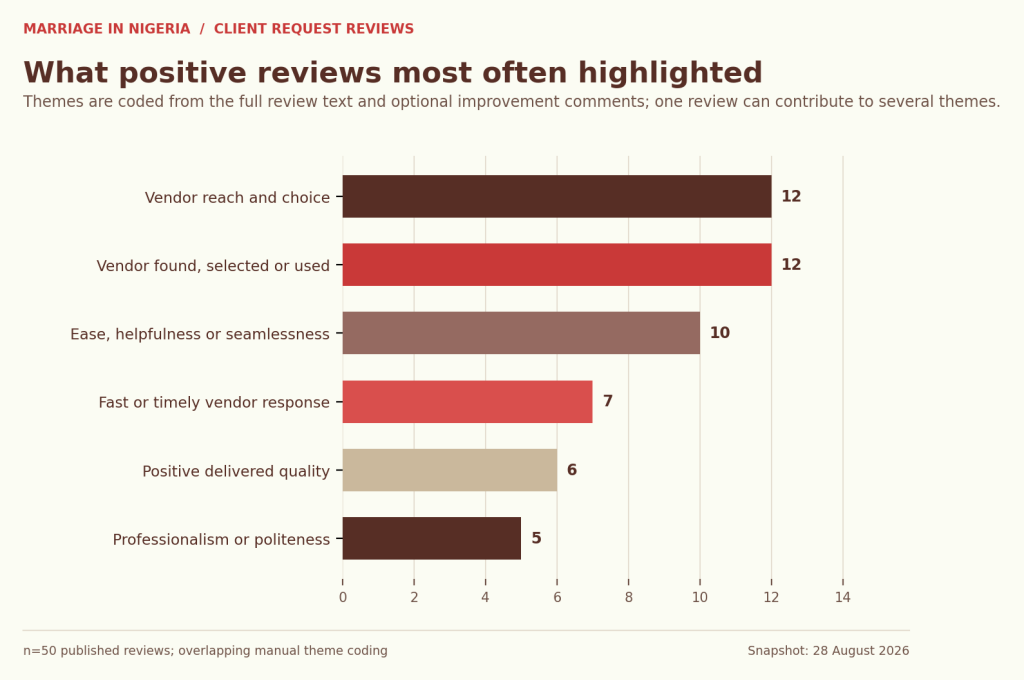
- 12 reviews explicitly say the requester found, selected, engaged or used at least one vendor through the platform.
- Eight reviews explicitly describe no suitable platform match, no platform-sourced use or an unmet outcome.
- The remaining 30 reviews do not state a definitive final outcome. They may describe outreach, comparison or general experience without confirming a booking.
- The requests linked to these reviews contain 387 service selections across 22 categories.
- 40 of the 50 requests – 80% – asked for more than one service.
- The reviews are attached to events across 16 state-level location labels, including Abuja, but Lagos contributes 19 of the 50 reviews.
These are platform-specific findings. They describe the current body of published reviews on Marriage In Nigeria; they are not a national survey of every couple, every wedding or every wedding vendor in Nigeria.
A 3.98 Average Is Strong, but the Distribution Matters More
An average rating can be reassuring while still hiding the experiences that matter most for improvement.
The 50 published reviews break down as follows:
- 21 five-star reviews
- 14 four-star reviews
- 11 three-star reviews
- 1 two-star review
- 3 one-star reviews
The combined four- and five-star share is 70%. That is a meaningful positive signal. Most published reviewers rated the experience favourably, and five-star ratings form the single largest group.
However, the 30% who gave three stars or fewer are equally important to understanding how the marketplace performs. A three-star review often reflects partial value: vendors may have responded, but the options were too far away, too expensive or unrelated to the request. A one- or two-star review is more likely to describe no useful response, no suitable match or concern about trust.
That distinction matters because the goal is not merely to generate activity. It is to help the right requester and the right vendor find one another.
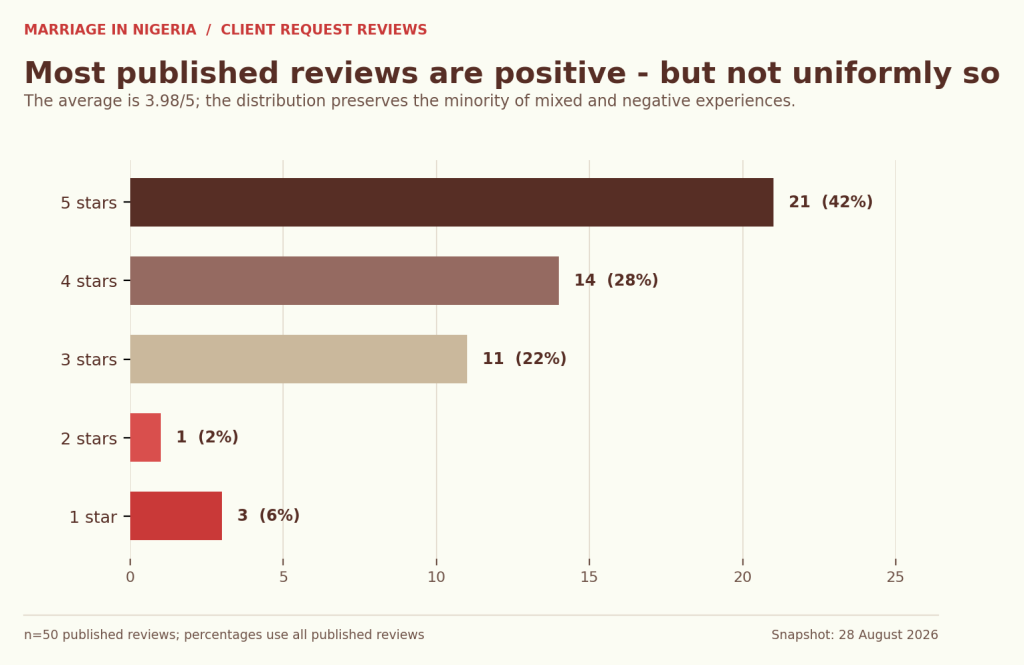
The distribution suggests a platform with a strong foundation and clear room to improve consistency. The next stage of growth is not simply more responses; it is a higher proportion of responses that fit the requester’s location, service, budget and confidence requirements.
Recommendation Is High, but It Is Not Universal
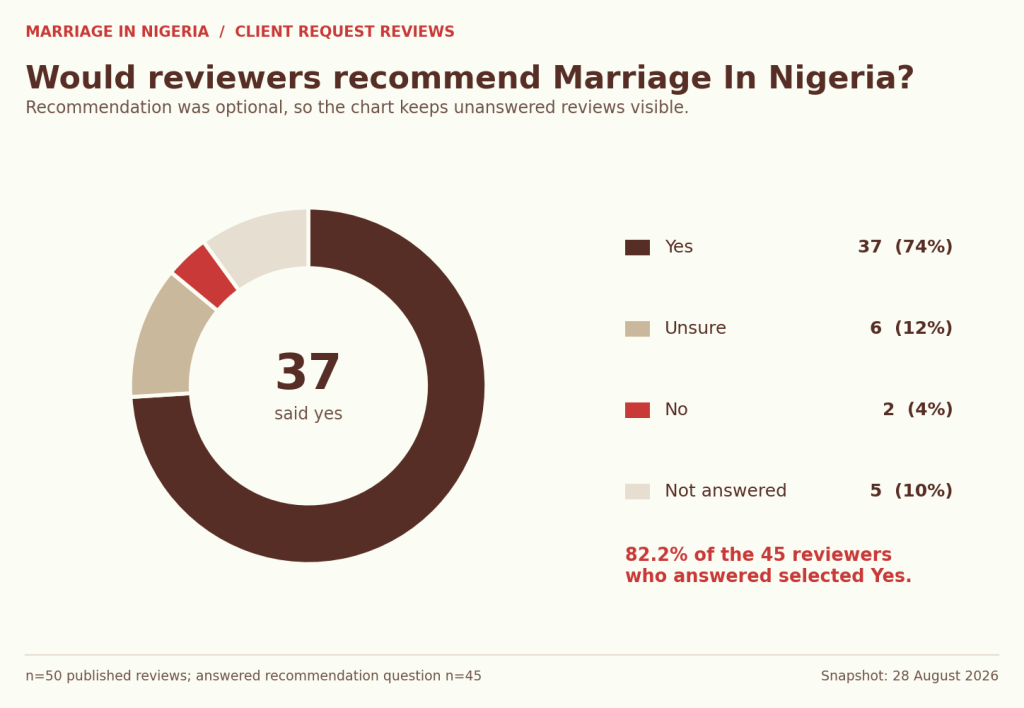
The recommendation question was optional. Forty-five of the 50 published reviewers answered it:
- 37 said yes
- 6 were unsure
- 2 said no
- 5 did not answer
Among those who answered, 82.2% said they would recommend Marriage In Nigeria. Across all 50 published reviews, the confirmed yes responses represent 74%.
Both percentages are useful, but they answer different questions. The first describes people who expressed a recommendation preference. The second keeps the five missing answers in the denominator and avoids assuming what those reviewers would have selected.
The unsure responses deserve attention. They are not necessarily a rejection of the concept. Several mixed reviews recognise that vendors reached out or that conversations were useful, while also saying the final options did not meet the request. In other words, a requester can appreciate access to vendors and still remain unconvinced by the quality of the match.
The Strongest Part of the Experience Is Discovery
The most consistent positive pattern is that the platform helps people move beyond a blank search.
Twelve reviews mention vendor reach, multiple options, several offers or enough responses to compare. Ten describe the experience as easy, helpful, seamless or stress-reducing. Seven explicitly praise fast, prompt or immediate vendor outreach.
One requester wrote:
“Vendors reached out and I was able to narrow down to the preferred.”
Another said:
“I was able to get multiple vendors and picked from them.”
Those comments identify the first layer of marketplace value: reducing the work required to discover relevant professionals. Instead of searching through scattered social pages, requesting recommendations in several groups and repeating the same brief to different businesses, a requester can post a wedding vendor request once and allow interested vendors to begin the conversation.
This does not remove the need for comparison or due diligence. It creates a more structured starting point.
Speed Creates Momentum – Relevance Creates Value
Fast contact is one of the clearest strengths in the reviews. Requesters describe responses as timely, prompt, immediate and swift. In wedding planning, that matters. A quick response can reduce uncertainty, show availability and allow a couple to compare options while the date is still open.
“The response rate of vendors was timely.”
But speed alone is not enough.
One reviewer praised quick outreach and then explained that vendors in the target location were difficult to find. The available businesses were too far away, which would have increased logistics costs. That review captures an important marketplace lesson: response time and match quality are different metrics.
A fast reply from the wrong city, an unrelated category or a price level far outside the stated budget may still leave the request unresolved. The best response is not simply the first. It is the first credible, relevant and clearly presented response.
For vendors, that means speed should be paired with substance:
- Confirm availability for the event date.
- State the city or state from which the team will travel.
- Explain any logistics or travel costs early.
- Respond to the exact service requested before offering extras.
- Give a useful price range or package summary where possible.
- Link to relevant portfolio examples rather than a general social page.
- Respect the requester’s preferred contact method and best contact time.
Choice Helps Requesters Move From Interest to a Decision
The reviews repeatedly show why alternatives matter. A single vendor contact gives a requester one possible answer. Several suitable contacts allow comparison.
Requesters describe narrowing down to a preferred option, entering negotiations, comparing prices and selecting from multiple offers. This decision stage is where a directory and a request marketplace can complement one another. A person can browse the wedding vendor directory directly, while a posted request allows suitable vendors to respond to a specific brief.
Choice is especially useful when the alternatives are genuinely comparable. A list of responses becomes more useful when each vendor makes the following clear:
- what is included in the package;
- what is excluded;
- the price or realistic price range;
- whether transport, accommodation or setup fees apply;
- what deposit is required;
- the cancellation, rescheduling and refund terms;
- the expected delivery timeline;
- examples of similar work.
This turns contact volume into decision quality.
Some Reviews Describe Real Vendor Outcomes
Twelve of the 50 published reviews explicitly state that the requester found, selected, engaged or used at least one vendor. These include accounts of finding a planner, decorator, caterer, photographer, Alaga or security provider.
Several of those reviews go beyond contact and describe delivered work or an ongoing professional relationship. For example:
“A very affordable bouncer reached out to me personally and he delivered perfectly.”
Another requester wrote:
“I searched for a decorator and I found one that did a very good job.”
These accounts are meaningful because they show the complete value chain can happen: request, contact, selection and service.
They should still be interpreted carefully. The 12 narratives are not a platform conversion rate. Reviewers are not a random sample of every request poster, not every review states whether a booking occurred, and some events had not yet taken place when the review was written. The correct conclusion is narrower: the published feedback contains clear examples of platform-sourced vendor selection and use.
A Review Is Not Automatically a Booking Record
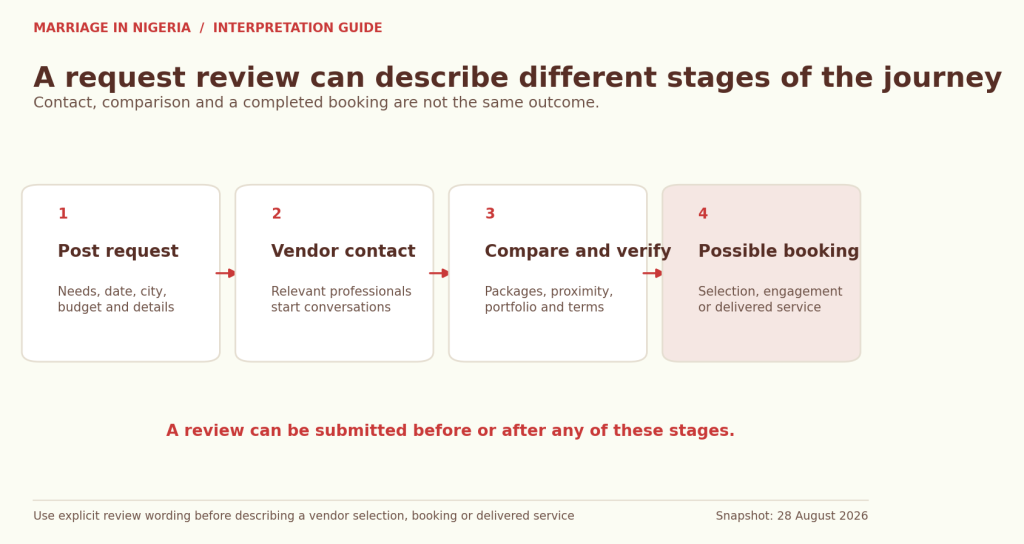
Eight published reviews explicitly say the requester did not use a platform vendor, did not find a suitable match or did not achieve the intended result. Thirty others do not state a definitive final outcome.
That large unclear group is not a failure category. It includes reviews that praise fast responses, useful conversations or a generally good experience without saying whether a contract was signed. It may also include people who were still comparing vendors, whose events were months away or whose plans later changed.
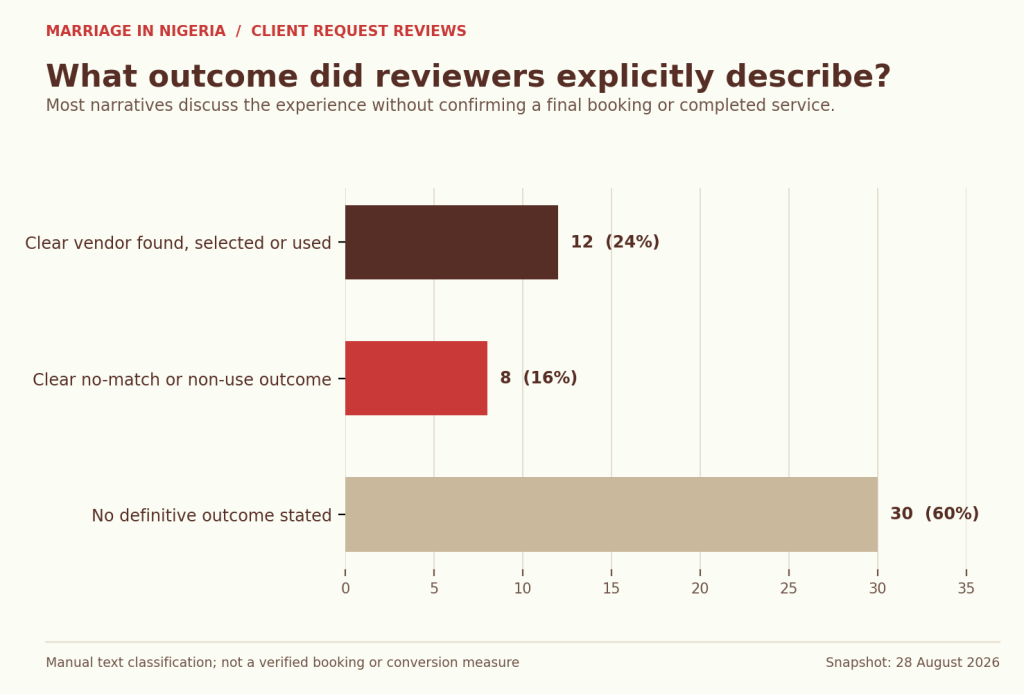
This is why the article avoids equating an open conversation, a closed request or a positive review with a confirmed booking. Better outcome measurement would ask distinct questions:
- Did at least one relevant vendor contact the requester?
- Did the requester shortlist or negotiate with any vendor?
- Did the requester select a vendor introduced through Marriage In Nigeria?
- Was a deposit or contract completed?
- Did the vendor deliver the agreed service?
- How satisfied was the requester after delivery?
These stages would make future editions even more useful without exaggerating what the current review text proves.
Local Relevance Is One of the Clearest Friction Points
Five reviewers explicitly describe vendors being too far away, coming from another state or being poorly matched to the event location. In three of those cases, distance was also connected to higher prices or logistics costs.
One requester summarised the issue plainly:
“I believe location matters in planning your wedding.”
That lesson aligns with the platform’s broader Wedding Demand Trends report, which shows that people posting requests overwhelmingly prefer vendors within their city or state. Locality affects more than convenience. It can influence:
- transport and accommodation costs;
- knowledge of the venue and local suppliers;
- setup and arrival time;
- the ease of holding physical meetings or rehearsals;
- familiarity with local customs and event expectations;
- the ability to respond to last-minute changes.
The goal should not be to prevent vendors from travelling. Many businesses serve several cities successfully. The goal is to make travel visible early enough for a requester to judge the full cost and practicality of the match.
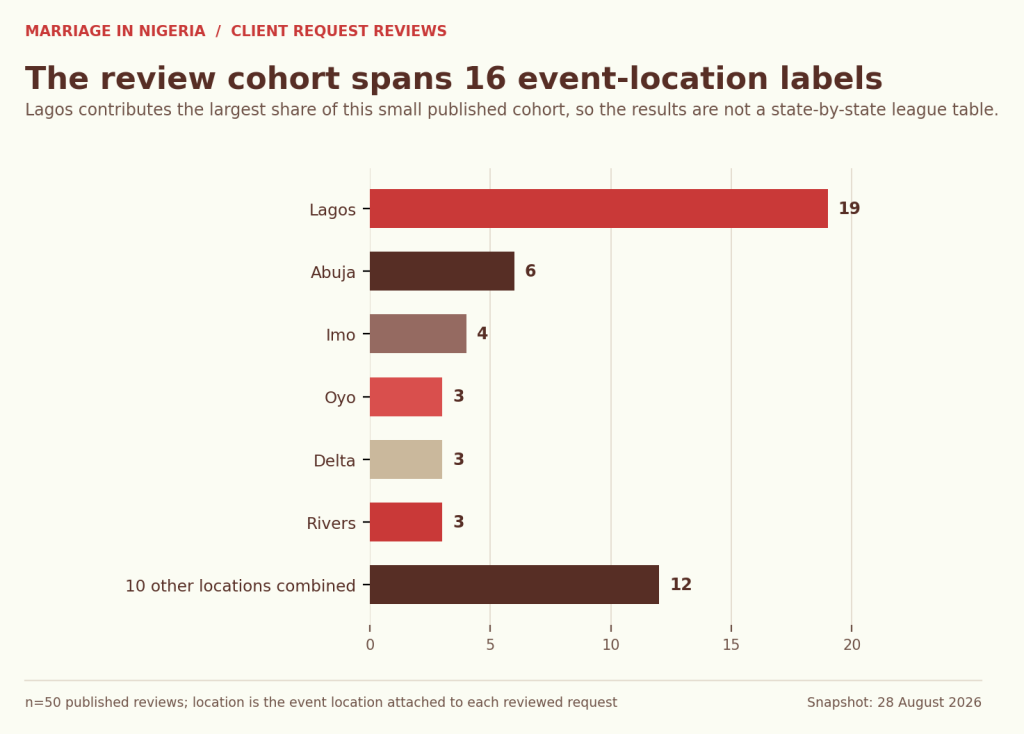
The location chart describes the review cohort, not national wedding activity. Lagos accounts for 19 of the 50 published reviews, while Abuja accounts for six. The remaining reviews cover 14 other state-level location labels. Results from this snapshot should therefore not be used to rank states or claim that couples in one location are more satisfied than those in another.
Trust Is Part of the Product Experience
Five reviewers asked for clearer verification, stronger safeguards or more visible accountability before money changes hands. Significantly, four of those five reviewers still gave four stars.
This is a useful lesson. Improvement requests do not come only from dissatisfied users. A person may appreciate the number of vendors who responded and still want stronger confidence signals before making a financial commitment.
The reviews should not be treated as proof that fraud occurred. They show that uncertainty itself affects the experience. In a wedding transaction, a requester may be considering a large deposit for a service that will be delivered months later. Confidence can depend on:
- a complete and internally consistent business profile;
- clear contact and business information;
- recent, relevant portfolio evidence;
- references or reviews that can be checked;
- a written quotation and scope;
- deposit, cancellation and refund terms;
- professional communication;
- receipts and documented payment records;
- a verifiable account name and business identity.
Marriage In Nigeria describes itself as a platform for discovery and direct communication. Couples and vendors independently decide whether to work together. Its responsible connection guidance encourages couples to review portfolios, verify business information, discuss expectations and assess vendors carefully before paying.
That is the right baseline. A profile, badge or contact marker can support discovery, but it should never replace the requester’s own checks. Couples can also read what people often overlook when hiring wedding vendors, including written availability, payment schedules, refund terms, receipts and contingency plans.
Price Is Not Only About Being Cheap
Seven reviews directly mention affordability, budget fit, high prices, transparent pricing or the ability to compare prices. An eighth links travel distance to a higher total cost.
The feedback is mixed in a useful way. Some reviewers celebrate finding an affordable professional or being able to compare multiple prices. Others say vendors were outside their budget or did not state pricing clearly enough.
This suggests that the marketplace does not need a race to the lowest price. It needs clearer fit.
For requesters, a budget works best when it explains scope. Is the amount for the whole event or only for the selected services? Does it include logistics? Is it a firm ceiling or a planning estimate? For vendors, a response is stronger when it explains what the stated amount buys.
A helpful quote should make it easy to see:
- the package name and price;
- the exact deliverables;
- quantity, hours or coverage period;
- staffing and equipment included;
- logistics and travel charges;
- optional additions;
- deposit and balance schedule;
- validity period of the quote.
Clear pricing does not guarantee agreement, but it allows both sides to identify a mismatch earlier and move on respectfully.
Request Complexity Explains Why Outcomes Can Be Partial
The 50 reviewed requests contain 387 service selections across 22 categories. Forty requests – 80% – involve more than one service. The middle of the distribution falls between seven and eight selected categories.
The most frequently selected services in this cohort are decor, photography, venue, DJ and videography. These counts overlap because a single request can ask for many professionals.
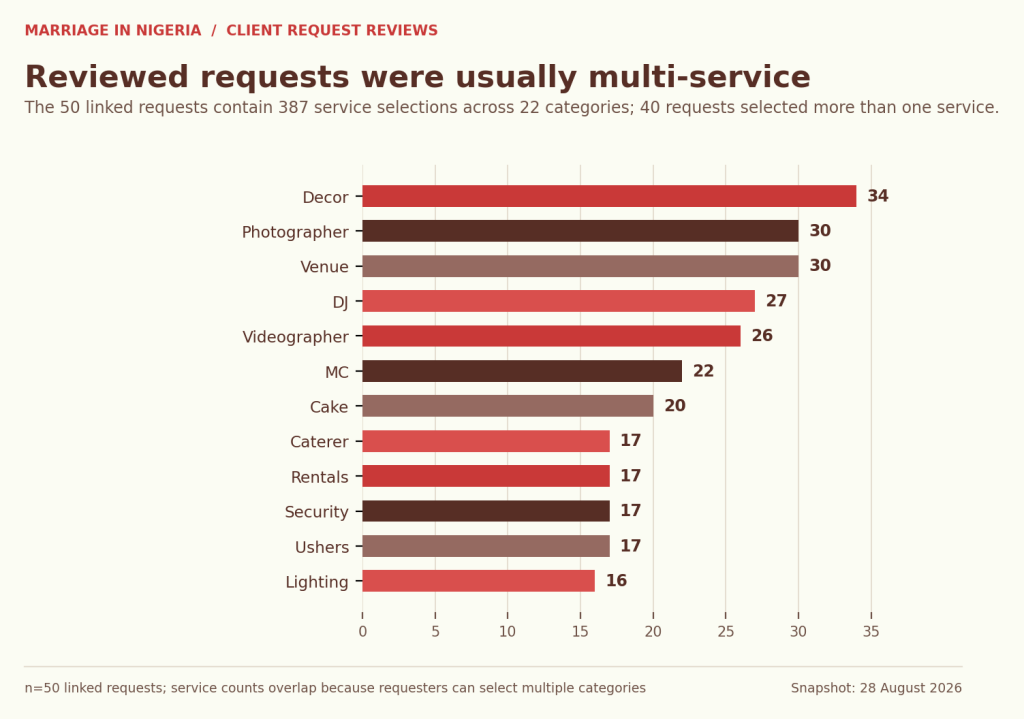
This complexity changes how success should be understood. A requester may need a venue, planner, photographer, caterer and decorator, but find only two of them through the platform. The review can be both positive and incomplete.
One published reviewer illustrates this clearly: the original search for a hall did not produce the desired venue, but it led to an affordable photographer who reportedly did very good work. Another reviewer found an Alaga and described her as professional, while still asking for stronger representation from other service fields.
Those are not contradictions. They show that a multi-service request can produce several different outcomes at once.
The Wedding Vendor Landscape report provides the supply-side companion to this observation. A national directory can have broad coverage while still needing deeper representation for a particular service in a particular location.
High Ratings Still Contain Valuable Product Advice
Fifteen of the 50 published reviewers provided a concrete, actionable suggestion. Nine of those 15 gave four or five stars.
The suggestions fall into five primary priorities:
- verification and safeguards;
- platform response, communication and follow-up;
- category breadth and vendor availability;
- closer local matching;
- pricing transparency or vendor conduct.
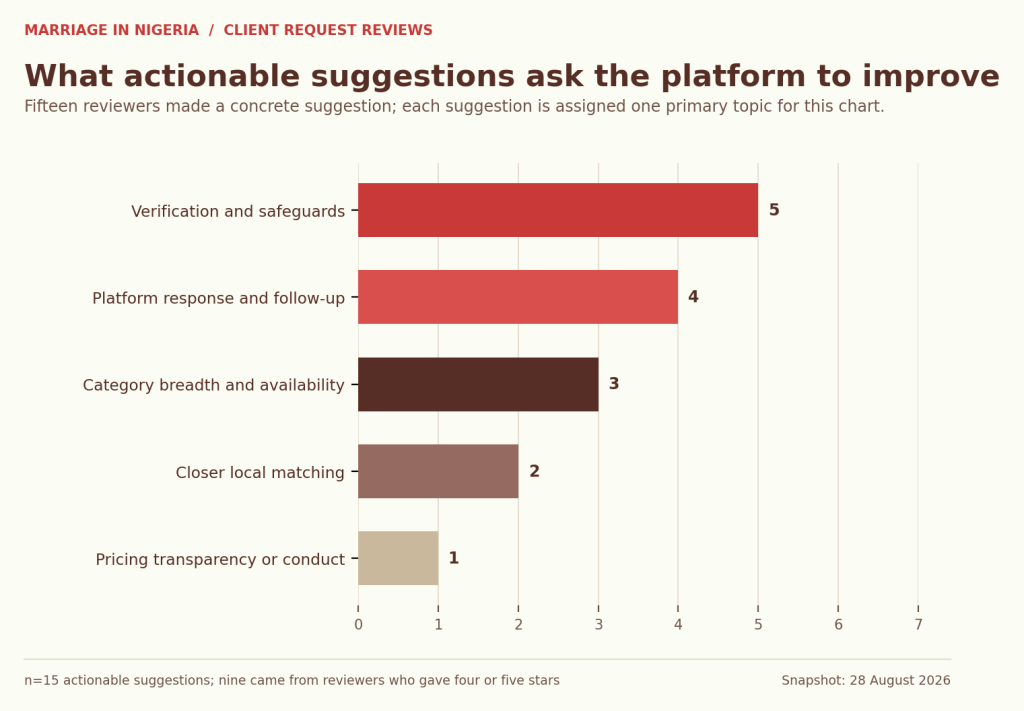
This is why feedback should not be divided too quickly into promoters and detractors. A four-star reviewer may be one of the best sources of product direction: they experienced enough value to understand the platform, but they can still identify the point where confidence or relevance weakened.
The most practical improvement principle is simple:
Do not optimise only for the number of contacts. Optimise for the number of credible, local, relevant and budget-aware conversations that can progress to a decision.
What Marriage In Nigeria Can Learn From the Reviews
The feedback points to several platform priorities. These are interpretations of the review patterns, not announcements of features that already exist.
1. Increase Local Depth, Not Just National Totals
Marketplace size is useful, but a requester experiences supply through a narrow filter: one service, one date, one city and one budget. Local onboarding should therefore be measured by category and location together.
A city with many photographers but very few venues, rental businesses or security providers may still feel incomplete to a person planning a multi-service event.
2. Improve Match Relevance Before Expanding Response Volume
The request should guide who responds. Location, service, date, guest count and budget are not decorative fields; they are the core of relevance.
Better routing can reduce unrelated pitches, avoid avoidable logistics surprises and help vendors focus on opportunities they can realistically serve.
3. Make Confidence Signals Easier to Evaluate
The reviews show demand for stronger trust and accountability. Useful steps can include clearer business details, more structured portfolio evidence, visible verification scope, better safety education and prompts that help couples ask the right questions.
Any confidence marker should explain exactly what has and has not been checked. It should not create a guarantee that the platform cannot support.
4. Make Contact Preferences Operational
Two reviewers raised concerns about vendor etiquette or contact timing, including late calls. The request already contains communication preferences. Vendors should be reminded to respect them.
Good outreach is timely, relevant and courteous. Persistence becomes counterproductive when it ignores boundaries.
5. Structure Quotes for Easier Comparison
Requesters value choice, but comparing informal WhatsApp messages can become another source of stress. A structured quote format would make package, price, logistics, deposit and exclusions easier to compare.
6. Close the Outcome-Measurement Loop
Future feedback can distinguish response, shortlist, selection, payment, delivery and post-event satisfaction. This would produce more reliable conversion and quality insights than inferring outcomes from open-text reviews.
What Couples and Event Planners Can Do to Get Better Responses
The platform can improve matching, but the quality of the request also matters. A clear brief helps the right vendors recognise a suitable opportunity.
Be Exact About Location
State the city, local government area or neighbourhood where possible. If the venue is undecided, say which areas are acceptable and whether you need venue suggestions.
Separate Essential Services From Optional Ones
If 12 services are selected but only five are urgent, say so. This helps vendors understand the priority and reduces unrelated responses.
Explain the Budget Clearly
State whether the budget applies to one service, all selected services or the full wedding. If the amount is flexible, explain what could make it move.
Add Enough Detail for a Real Quote
Guest count, event type, date, venue status, expected hours, style, deliverables and special requirements can change a vendor’s price substantially.
Set Contact Boundaries
Choose the preferred contact method and best time. If you want messages before calls, say so directly in the request details.
Compare Evidence, Not Only Claims
Review recent work that resembles your event. Ask who will personally deliver the service, what backup plan exists and whether the quoted team is the team that will attend.
Put Agreements in Writing
Confirm scope, dates, payment schedule, cancellation terms, logistics and what happens if the vendor cannot deliver. Keep receipts and payment confirmations.
Couples can post a wedding vendor request, browse current wedding vendor profiles or use the wedding planning checklist to organise the wider process.
What Wedding Vendors Can Learn From the Reviews
The published feedback is equally useful for businesses responding to requests.
Respond Quickly, but Read the Brief First
A fast generic pitch is weaker than a slightly slower response that addresses the event. Confirm date, location, service and budget fit before selling.
Lead With Relevance
Tell the requester why your business fits this particular need. Mention comparable work, realistic availability and the city from which you operate.
Make Pricing Easier to Understand
Do not send a number without scope. Explain deliverables, exclusions, logistics and payment stages. If the stated budget cannot support the request, say so politely and offer a smaller alternative where appropriate.
Build Trust Before Asking for a Deposit
Use a complete business profile, consistent contact information, a focused portfolio and a written quotation. Be prepared to provide references and answer practical questions.
Respect Contact Preferences
Do not assume an immediate phone call is welcome. A professional introduction through the requester’s selected channel is more likely to start a productive conversation.
Do Not Oversell Unrelated Services
If a requester asks for a venue, an unrelated planning package should not replace the requested answer. Additional services can be introduced after the core need has been addressed.
Wedding businesses can review the current wedding vendor requests and learn how to become a wedding vendor on Marriage In Nigeria.
How the Findings Were Calculated
This edition analyses the 50 client request reviews published on the public Marriage In Nigeria review page as of 28 August 2026. Each published review is counted once.
The quantitative analysis uses the star rating, optional recommendation answer, review date and non-personal request context needed to describe service scope, event type and location. Names, email addresses, phone numbers, IP addresses, device information and payment details are not part of the published analysis.
The qualitative analysis reads the review text together with the optional improvement comment. Themes are multi-label: one review can mention fast responses, local mismatch and price pressure at the same time. Each theme is counted at most once per reviewer.
For the actionable-suggestion chart, each of the 15 concrete suggestions is assigned one primary topic so the categories add to 15. This differs from the broader theme chart, where categories overlap.
Important Limitations
- Published-review bias: This is an analysis of reviews appearing on the public page, not a random survey of every person who has posted a request.
- Self-selection: People who choose to submit feedback may differ from people who do not respond.
- Small sample: Fifty reviews can reveal useful patterns, but they are not large enough for reliable state-by-state, service-by-service or causal comparisons.
- Different review stages: A person may review the platform after outreach, during negotiation, after selection or after the event.
- No automatic booking inference: A positive rating, a vendor response or a closed request does not prove that a booking occurred.
- No automatic quality guarantee: Individual reports of professional or successful service are testimonials, not a guarantee about every vendor.
- Overlapping service context: Service percentages should not be added together because most reviewed requests include several categories.
- Changing snapshot: The article is designed to be updated. Counts and percentages will change as more reviews are published.
Frequently Asked Questions
Are These Reviews of Individual Wedding Vendors?
No. They are reviews from people who posted wedding vendor requests on Marriage In Nigeria. Some reviewers discuss a vendor they found, but the rating primarily describes the request and connection experience.
Does a Five-Star Review Mean a Vendor Was Booked?
Not necessarily. A five-star reviewer may be praising quick contact, useful options or the overall platform experience. A booking is described only when the review explicitly says a vendor was selected, engaged or used.
How Many Reviews Are Included?
The current edition includes 50 published client request reviews. The permanent article can be refreshed as the live review page grows.
Were All Reviewers Satisfied?
No. Seventy percent gave four or five stars, while 30% gave three stars or fewer. The article includes both positive and critical themes.
Can Couples Rely on a Listing Without Doing Their Own Checks?
No. Couples should review portfolios, verify business information, obtain written terms, confirm payment details and assess every vendor before paying.
How Can Someone Ask Vendors to Respond to Their Wedding Needs?
Use the Post a Wedding Vendor Request page to provide services needed, event type, location, date, guest count, budget and other details.
Can Couples Search for Vendors Without Posting a Request?
Yes. The wedding vendor directory allows visitors to browse and filter profiles by service and location.
How Can Wedding Businesses Join the Platform?
Wedding professionals can read how to get listed on Marriage In Nigeria and review the available listing options.
How to Cite This Living Report
Publishers may cite aggregated findings and charts with attribution to Marriage In Nigeria and a link to the permanent article URL.
Suggested citation:
Marriage In Nigeria. “Wedding Vendor Search: Live Reviews From Marriage In Nigeria.” Updated 28 August 2026. https://marriageinnigeria.ng/wedding-vendor-search-reviews/
When quoting a statistic, include the snapshot date because the figures will change as new reviews are published.
Update History
| Date | Published reviews analysed | What changed |
|---|---|---|
| 28 August 2026 | 50 | First edition, including ratings, recommendations, qualitative themes, request context and improvement priorities. |
Final Perspective
The most important conclusion is not that the platform has an average rating close to four stars.
The more useful conclusion is that a wedding vendor request succeeds in stages.
First, the requester needs relevant professionals to respond. Next, those responses must offer enough information to compare. Then the requester must feel confident about location, price, professionalism and trust. Only after those conditions are met can a conversation become a selection, booking and successful service.
The current reviews show meaningful progress through that chain. Requesters report fast outreach, multiple options, easier discovery, useful negotiations and real vendor outcomes. They also show exactly where momentum can be lost: distant vendors, thin category coverage, unclear pricing, poor contact etiquette, weak follow-up or insufficient confidence signals.
For couples, the lesson is to write a precise request and verify carefully.
For vendors, the lesson is to respond quickly with relevance, clarity and professionalism.
For Marriage In Nigeria, the lesson is to keep improving the quality of the match – not only the volume of the response.
Readers can explore the latest client request reviews, post a request, browse the wedding vendor directory, compare this report with Wedding Demand Trends and read the companion Wedding Vendor Landscape analysis.