




Last updated: 17 November 2026. Figures are a dated platform snapshot. Live totals can change.
Wedding vendor search reviews offer a useful view of how people experience Marriage In Nigeria. This update analyses 100 published client request reviews from 100 distinct request records. The average satisfaction rating is 4.01 out of 5, and 77 reviews say they would recommend the platform.
However, a published review is not a booking audit. Some respondents describe finding or speaking with vendors before their event takes place. Therefore, the ratings measure their reported platform experience at the time of review, rather than verified wedding delivery.
The reviews in this snapshot were submitted from 29 May to 17 November 2026. You can read the current published client request reviews alongside this analysis. That page may gain more feedback after this update.
Wedding vendor search reviews at a glance
| Measure | Published review sample |
|---|---|
| Published reviews | 100 |
| Distinct request records | 100 |
| Mean satisfaction rating | 4.01 / 5 |
| Ratings of 4 or 5 | 72 (72%) |
| Would recommend: yes | 77 |
| Recommendation not answered | 9 |
| Optional improvement text supplied | 43 |
First, keep each denominator clear. Ratings use all 100 published reviews. The recommendation question is optional, so it has 91 answered responses and nine unanswered entries. Also, a written improvement suggestion does not automatically indicate a poor rating.
What the current client review form asks
The form asks for overall satisfaction on a five-point scale. It labels 1 as very dissatisfied and 5 as very satisfied. Next, the respondent writes about their experience and can optionally explain what could improve.
In addition, the form offers a recommendation question with Yes, No and Not sure yet choices. It can also offer a request-closure choice in the relevant circumstances. However, none of those questions directly asks how much a client paid or independently verifies a vendor’s final delivery.
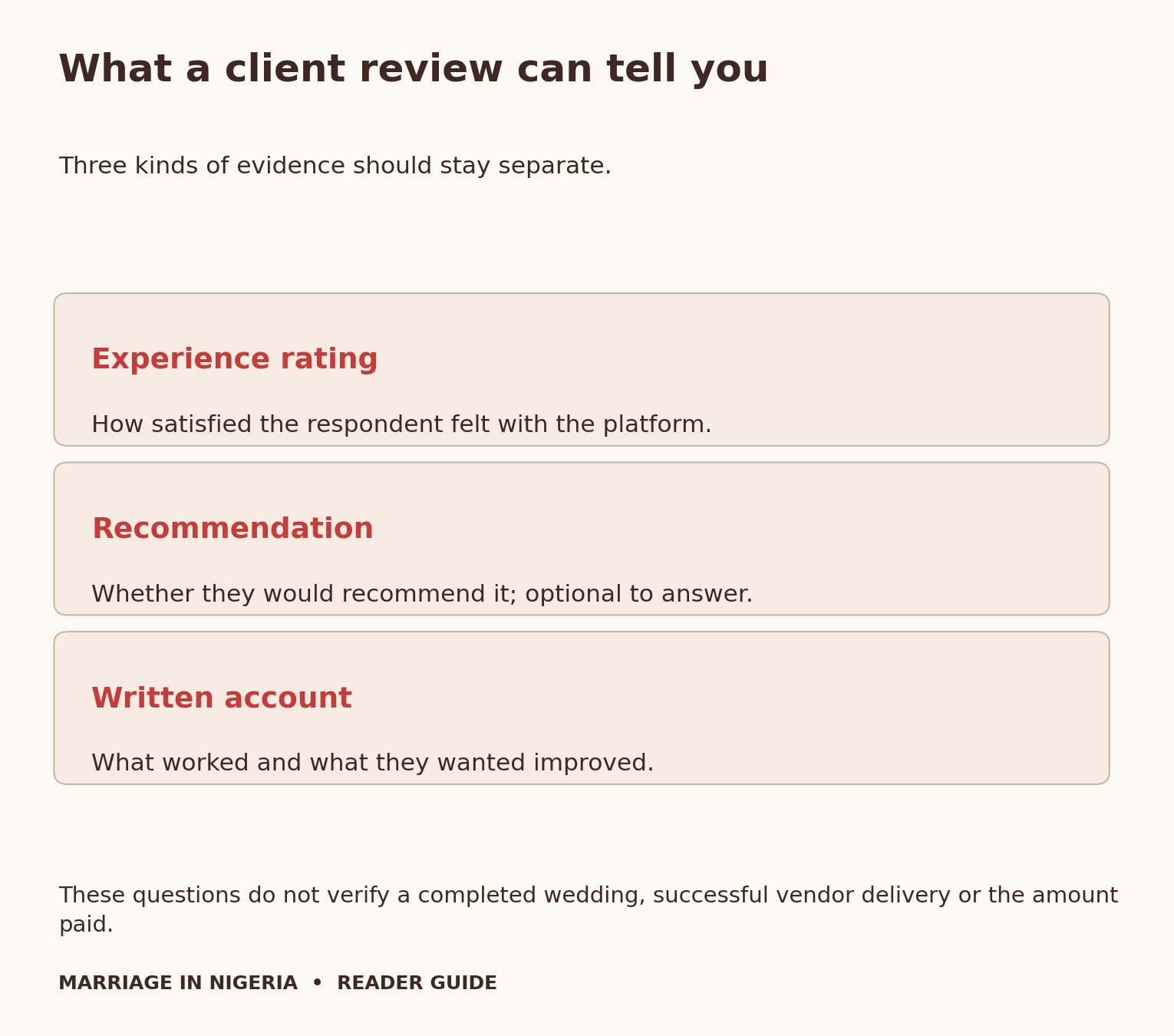
Consequently, three kinds of evidence should remain separate: satisfaction, recommendation and the written account. They can inform each other, but they do not measure the same thing. For example, someone may appreciate a quick introduction while still waiting for the event.
The satisfaction distribution shows more than the average
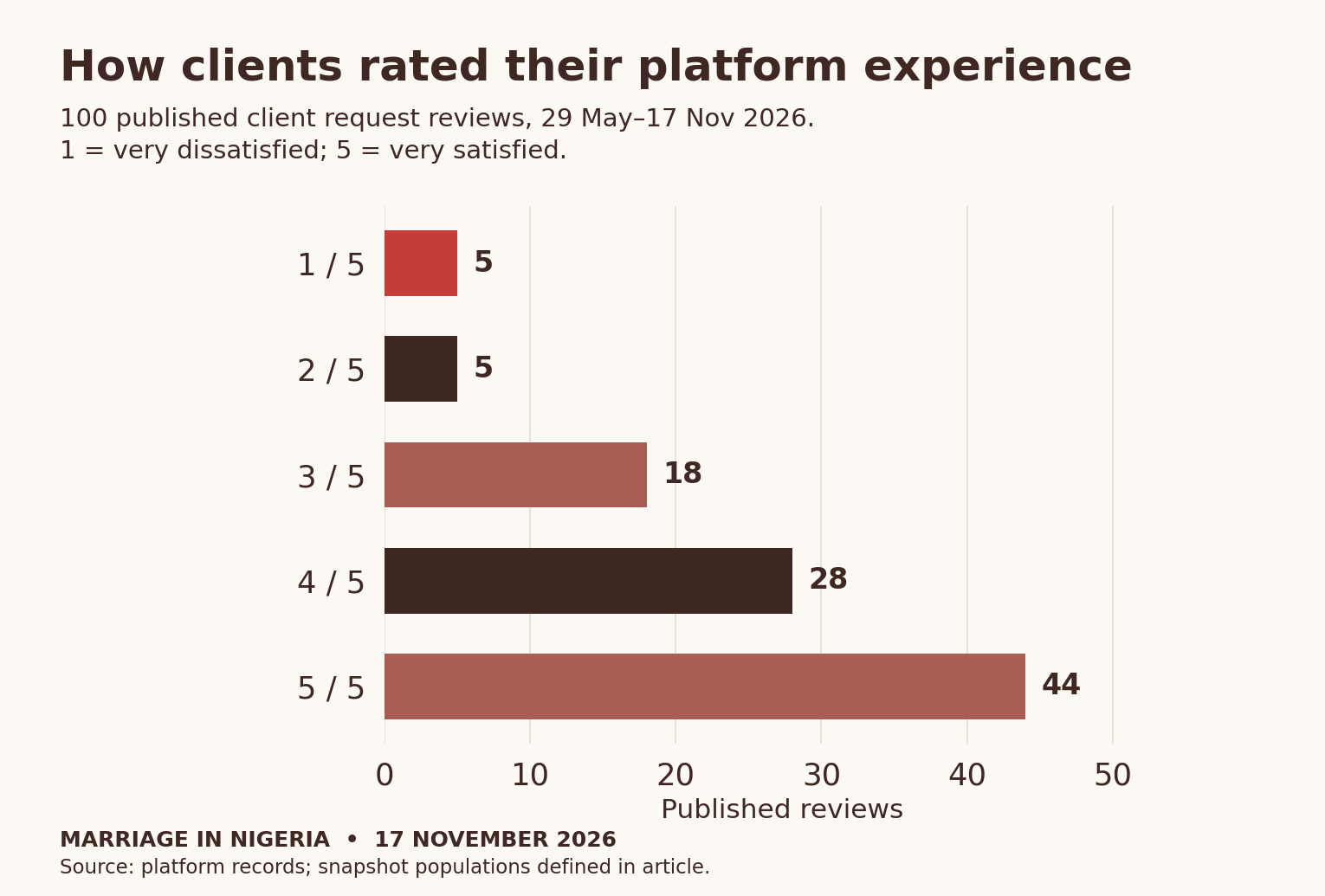
The most common rating is 5, given in 44 reviews. Another 28 give a rating of 4, while 18 choose 3. Finally, five choose 2 and five choose 1.
| Rating | Published reviews | Share |
|---|---|---|
| 1 / 5 | 5 | 5% |
| 2 / 5 | 5 | 5% |
| 3 / 5 | 18 | 18% |
| 4 / 5 | 28 | 28% |
| 5 / 5 | 44 | 44% |
Together, ratings of 4 and 5 account for 72% of the sample. Meanwhile, the two lowest ratings account for 10%. The average of 4.01 comes from a total of 401 rating points divided by 100 reviews.
However, an average can hide different experiences. A reader should look at the full distribution and the written accounts, not just the headline. Also, these are published reviews rather than a random sample of every requester.
Recommendation has an optional-answer boundary
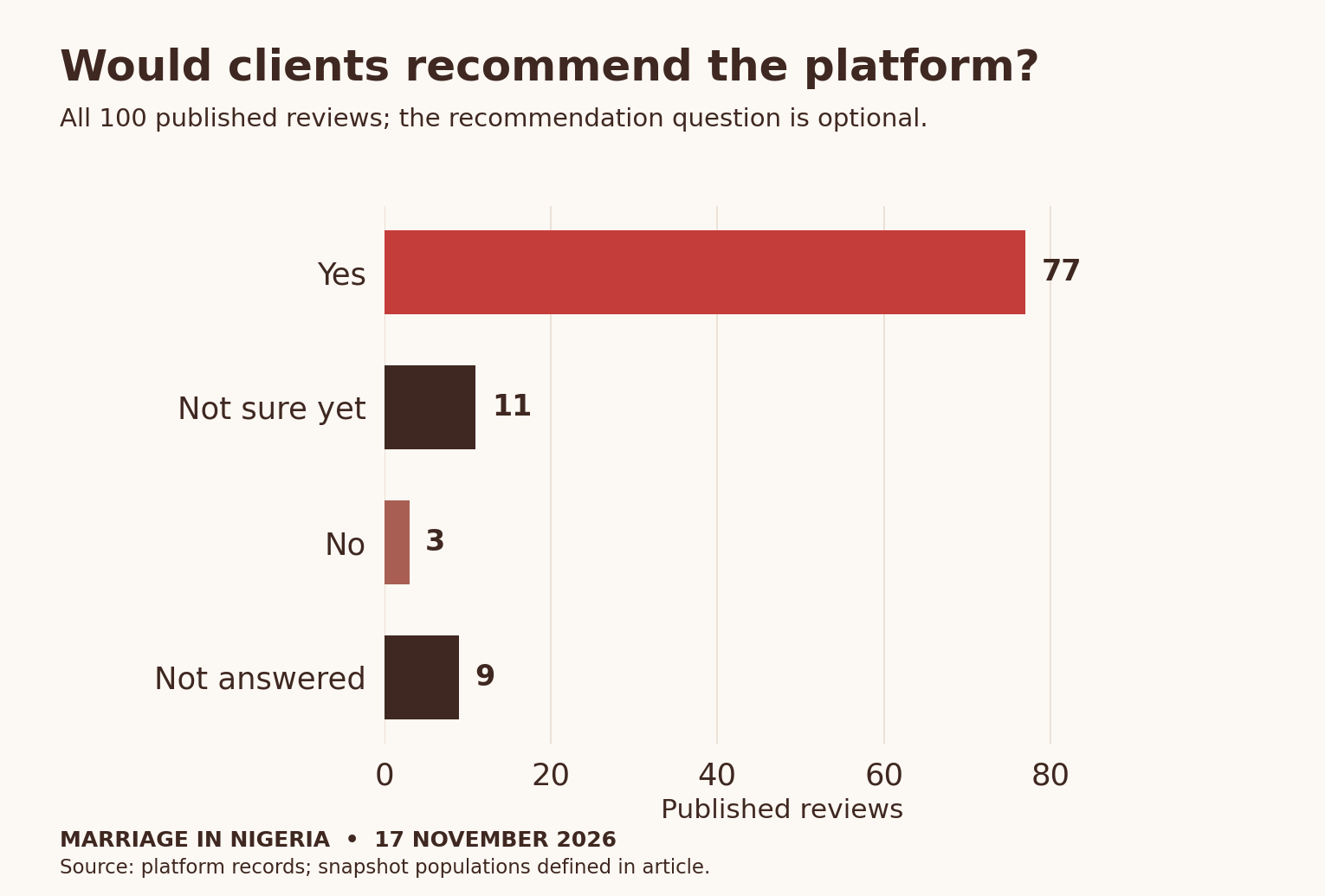
There are 77 Yes responses, 11 Not sure yet responses and three No responses. Nine reviews leave the question unanswered. Therefore, the clearest headline is that 77 of all 100 published reviews say Yes.
| Recommendation | Reviews | Share of all 100 |
|---|---|---|
| Yes | 77 | 77% |
| Not sure yet | 11 | 11% |
| No | 3 | 3% |
| Not answered | 9 | 9% |
Among only the 91 answered responses, Yes represents 84.6%. However, that is a different denominator from the full sample. We show the missing answers rather than quietly treating them as support or opposition.
Likewise, Not sure yet is its own answer. It may reflect an unfinished planning journey, uncertainty or another reason. The form does not establish which explanation applies to each person, so we do not guess.
The published feedback covers several months
June contributes the largest monthly group with 26 reviews. September follows with 20 and October with 18. November contributes nine reviews through the snapshot date.
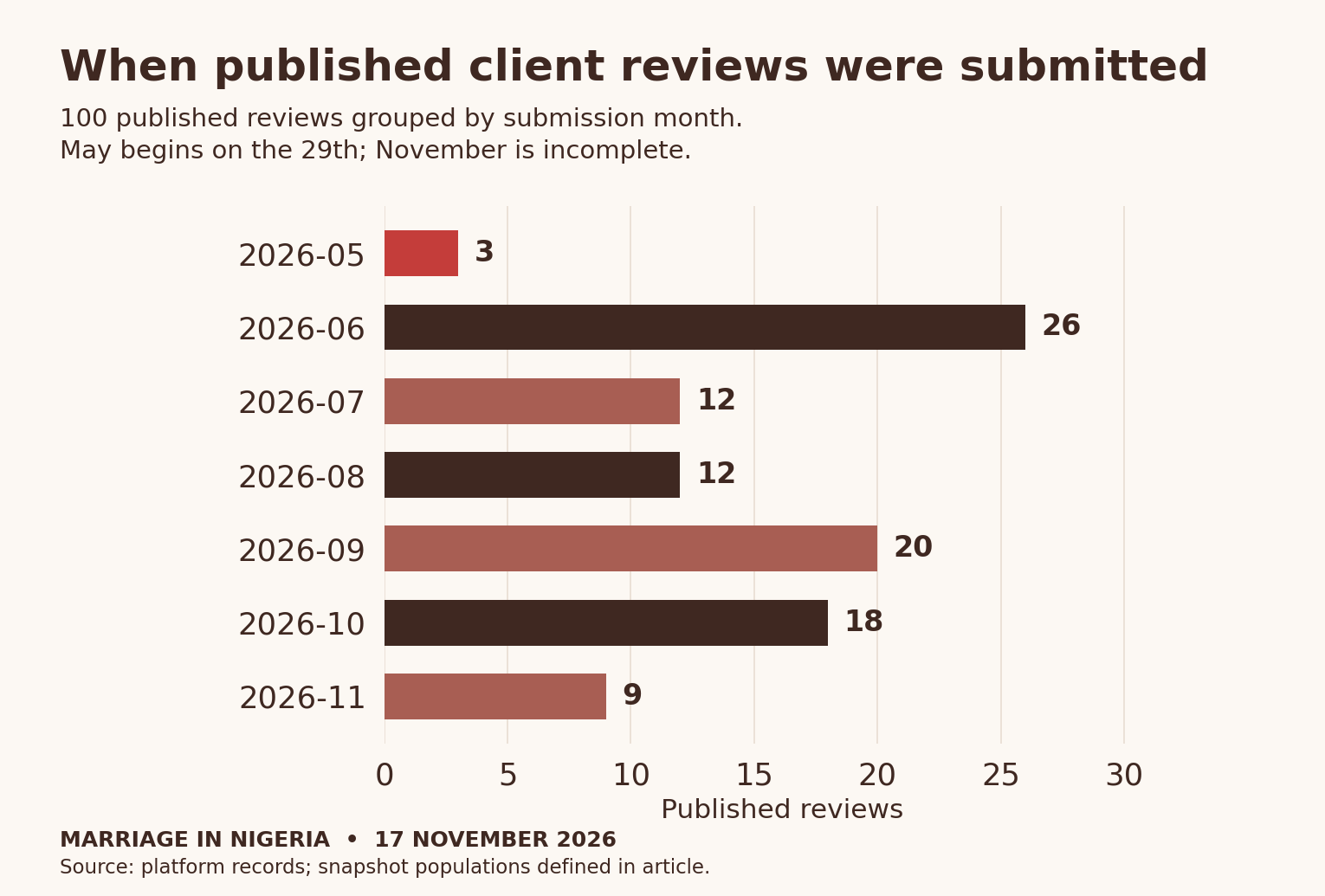
The series starts near the end of May and ends during November. As a result, it should not be read as seven equal observation periods. Also, invitation timing, submissions and moderation can affect the number of reviews that become public.
For that reason, monthly counts show when the published sample was submitted. They do not establish monthly satisfaction trends or changes in booking conversion. We would need a consistent invitation population and response history to answer those questions.
Which events appear in the review sample?
White Wedding is the associated request label for 38 reviews. White and Traditional Wedding follows with 24, then Traditional with 20. Together, those three groups account for 82 of the 100 reviews.
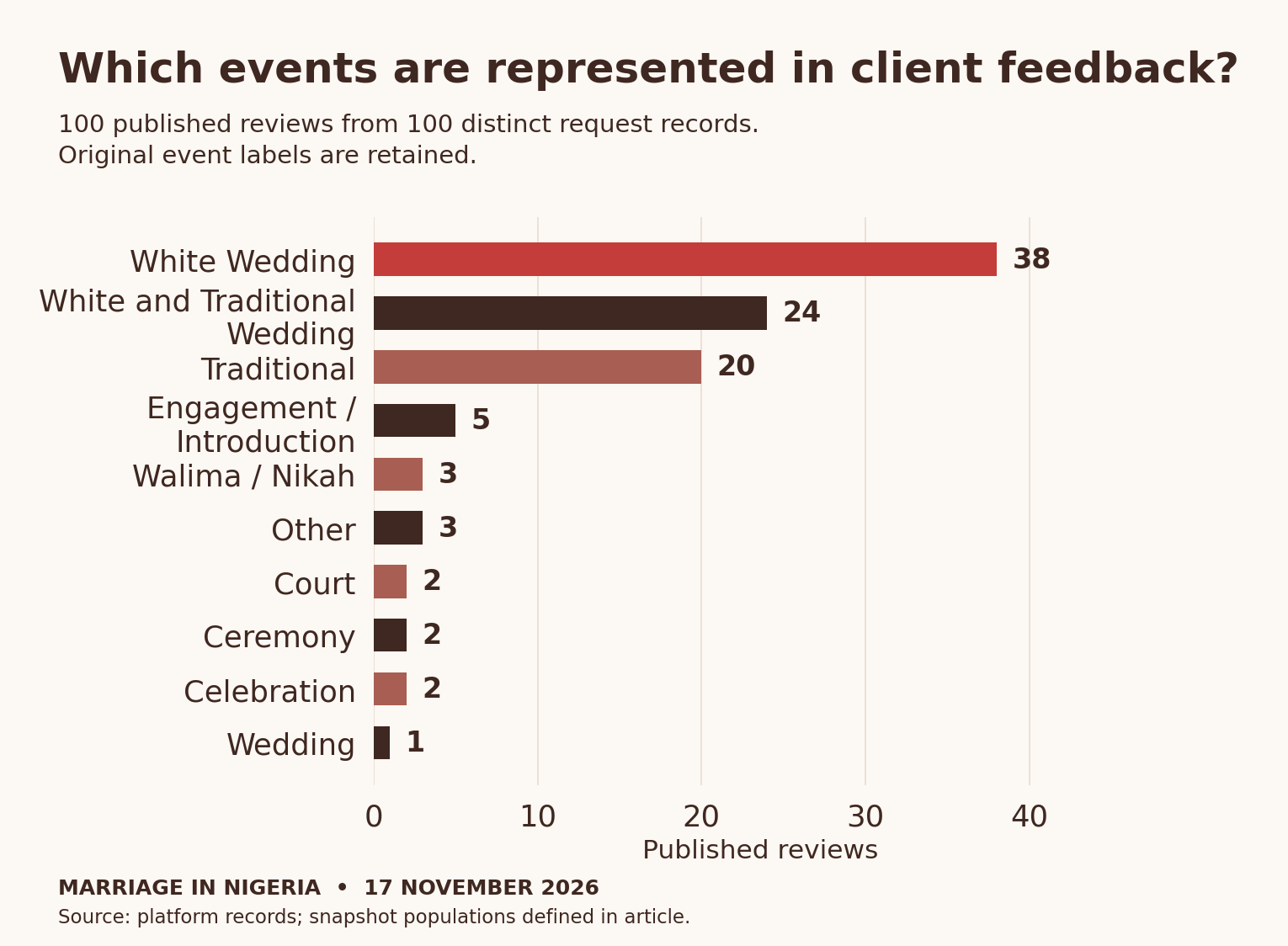
Other records include introductions, Nikah or Walima, court ceremonies and celebrations. However, small groups should not become rankings of which event types receive better service. Their counts are too limited, and the sample was not designed for that comparison.
Also, the unit here is a review linked to a request record. Although the sample contains 100 distinct request records, that does not establish 100 distinct people or 100 completed weddings.
What the written accounts add
The published accounts show why the form’s boundaries matter. For example, some people describe quick replies, helpful consultations or finding a provider that suits their budget. Others say their event has not happened yet or that they chose an alternative.
Meanwhile, critical accounts raise issues such as relevance of responses, limited choice, contact preferences and vendor delivery. These are qualitative observations from the visible feedback. We have not turned them into coded theme percentages.
That distinction avoids a common mistake. A positive introduction is useful, but it does not prove a successful final event. Similarly, a concern about one part of the experience should not be treated as evidence about every listed vendor.
Improvement suggestions deserve their own reading
Forty-three reviews contain text in the optional improvement field. The other 57 do not. However, an empty optional field cannot establish that a respondent had no concerns.
Also, a reviewer can give a high rating and still suggest a change. Therefore, rating counts and improvement-field completion should not be added together as if they were separate groups of satisfied and dissatisfied users.
For the platform, the useful next step is to review specific concerns in context. For clients, the lesson is to describe the brief clearly and check whether replies address it. A large volume of messages is less helpful when they do not match the requested service.
How couples can use wedding vendor search reviews
First, look for accounts that resemble your planning situation. Next, check whether a review discusses discovery, a conversation, a booking or completed delivery. Then return to the current provider profile and assess the actual offer.
For example, confirm the event date, setup time, deliverables and who will attend. Also, explain whether you prefer a call or a chat. Clear expectations can make both the first conversation and the eventual agreement easier to assess.
Finally, complete your own checks before paying. Marriage In Nigeria connects people with vendors, while the parties agree and manage their wedding-service transaction. The current FAQs explain how the platform works.
Methodology and limits
This edition counts reviews that are active, approved and attached to requests eligible for the public review view. It contains 100 published reviews from 100 distinct request records. Pending, declined or otherwise unpublished feedback is outside the published-review sample.
We use the recorded submission date for the date range and month counts. Ratings are the recorded integers from 1 to 5. The mean is their arithmetic average, while recommendation percentages keep unanswered entries separate.
However, this is a moderated, self-selected sample. The report cannot establish a response rate without a compatible invitation denominator. It also cannot establish satisfaction among every requester, every client or Nigeria’s wedding market.
What these reviews cannot verify
The client form does not independently verify booked revenue, payment amounts, contracts or completed events. Therefore, no rating or recommendation count becomes a conversion rate. We also exclude private contact information and avoid publishing personal request details.
A newer form or an older retained answer can reflect a different collection period. For this reason, we report the questions currently asked and use explicit denominators. We do not interpret unrelated audit fields as current answers.
Read the other marketplace evidence
Wedding vendor search reviews complement the request demand report and vendor landscape report. Those articles describe needs and listings, while this one describes published client experience.
For current options, browse wedding vendors or post a detailed request. Suggested citation: Marriage In Nigeria, “Wedding Vendor Search: Live Reviews From Marriage In Nigeria,” updated 17 November 2026.