






Overlapping wedding vendor quotes can make one event budget hard to reconcile. A venue may include basic sound while a DJ lists speakers separately. However, similar descriptions do not prove that you are paying twice. Compare the specification and responsibility first, then obtain an agreed written revision.
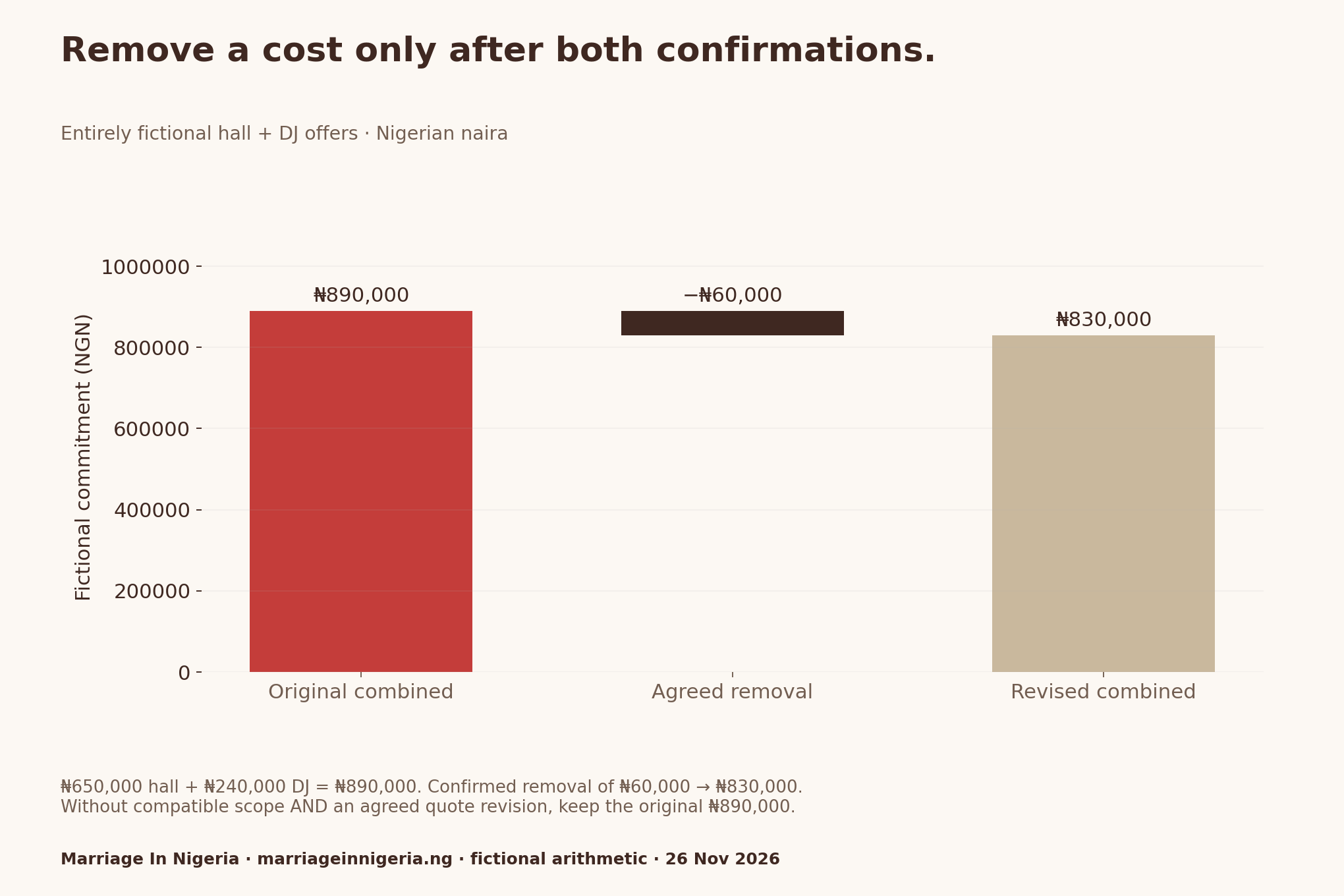
This report uses an entirely fictional hall-and-DJ example. The initial combined amount is ₦890,000. It falls to ₦830,000 only if the DJ confirms the venue system meets the requirements and agrees to remove a ₦60,000 speaker line. One chart, a two-approval infographic and four CSV tools show how to document that conditional decision.
What one request tells us about overlapping wedding vendor quotes
A public traditional-wedding request published on 24 November 2026 listed 11 services against a single ₦4 million budget. Its service selections included DJ, MC, venue, rentals and lighting, and its description sought cost breakdowns. This is one stated brief, not evidence of completed spending or overlapping proposals.
We checked the current request form before using the brief. The total budget covers the selected services, while optional service ranges allow more detail. Neither a service label nor a budget field proves what a supplier includes. Therefore, the reconciliation must use the actual dated quotes and accepted revisions.
This article does not publish the requester’s name, identifying venue details or contact data. Also, the fictional amounts below do not estimate that person’s costs or divide their stated budget. They create a separate, reproducible example of comparing two scopes.
Group possible duplicates without deleting them
First, copy each supplier’s quote into a common ledger. Keep the supplier name, version and date beside every line. Then group descriptions that may refer to the same deliverable, such as sound, lighting, chairs or transport. Mark them as possible overlaps rather than confirmed savings.
For each apparent match, ask about quantity, model, capacity, booked hours and who operates the equipment. For example, a venue’s basic sound system may serve a different purpose from the DJ’s setup. A shared label cannot resolve those technical questions. Ask the suppliers to check the actual requirement together.
Next, list missing costs alongside the apparent duplicates. Connection, transport, setup, operator time or collection may still need a named owner. However, do not invent fees to fill those gaps. Record each open question and obtain an amount or an explicit written inclusion from the responsible supplier.
A fictional ₦60,000 line changes the total only conditionally
In this invented case, the hall quote is ₦650,000 and includes basic sound. The DJ quotes ₦240,000, including a separate ₦60,000 speaker line. The original combined commitment is therefore ₦650,000 + ₦240,000 = ₦890,000. These are synthetic offers, not provider prices.
Suppose the DJ confirms in writing that the venue system satisfies the agreed requirements. Then suppose the DJ removes the speaker line without adding another charge. The DJ’s revised amount becomes ₦180,000, so the combined total becomes ₦830,000. Both confirmations are necessary for this calculation.
| Fictional case | Combined amount | Decision |
|---|---|---|
| Original offers | ₦890,000 | Keep both quote versions |
| Compatibility or revision unconfirmed | ₦890,000 | Leave the speaker line visible |
| Compatible scope and accepted removal | ₦830,000 | Use the signed revised version |
If either supplier cannot confirm the technical fit, keep both lines in the plan. Similarly, a statement that the venue has speakers does not authorize you to deduct money from the DJ’s invoice. The supplier must agree to the revised scope and price. Check the revised total before accepting it.
Separate technical fit from commercial agreement
Technical confirmation answers whether the replacement arrangement can do the agreed job. Commercial confirmation answers who removes which charge, what remains included and whether any new cost appears. As a result, treat these as separate approvals even when the same person helps coordinate both.
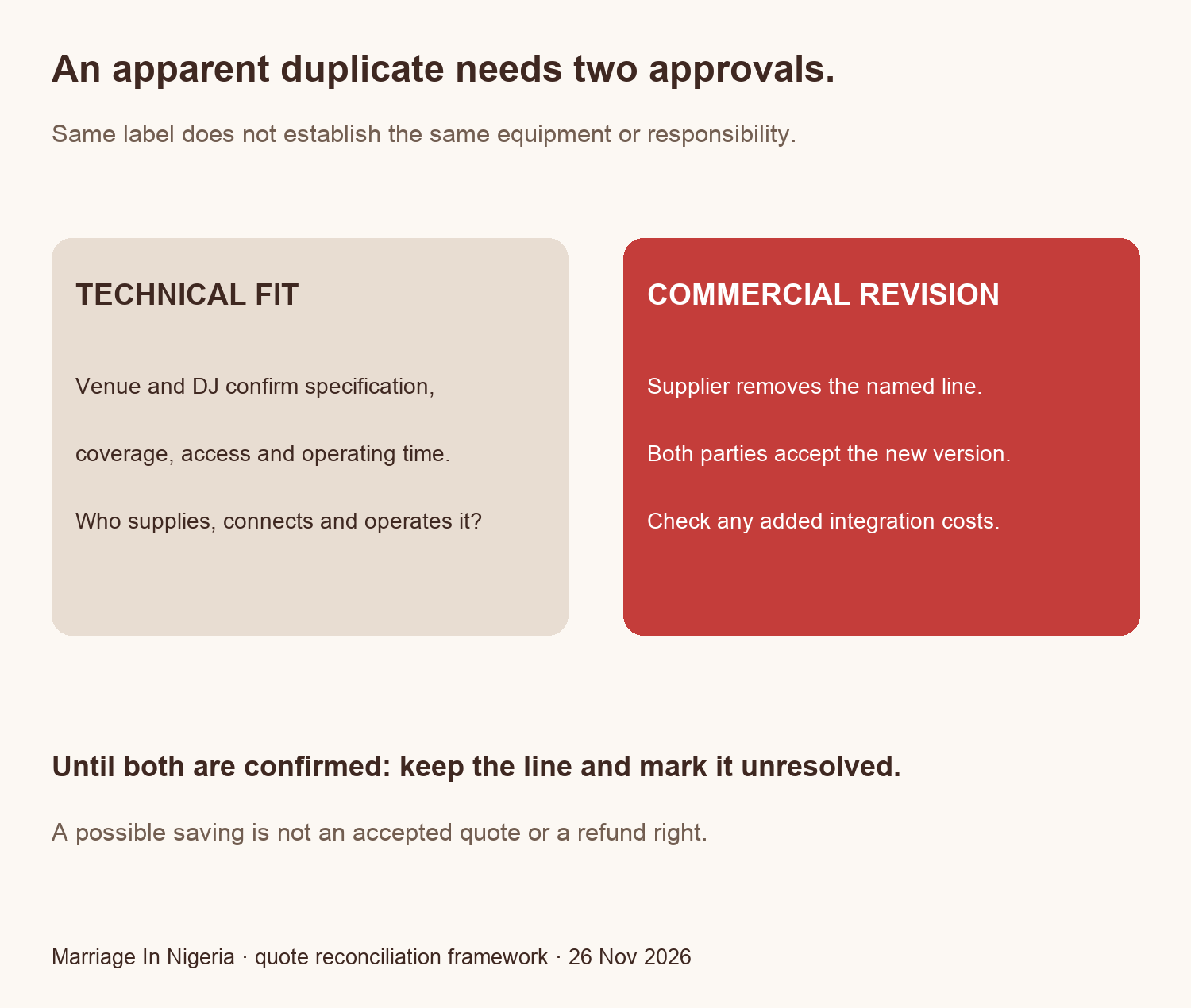
Ask both suppliers to identify the version they approved. Also record who connects, tests and operates the equipment, plus the setup window and fallback if the arrangement fails. A cheaper proposal with an unassigned task may leave an important gap. Make that gap visible before comparing the final totals.
Keep a cross-quote ledger and revision log
The blank ledger gives each comparison item a field for both quotes, a responsible owner and an evidence or open-question column. Use it to compare specification, timing, inclusion and exclusions. Then record the written change, removed charge, new cost and revised amount in the separate revision log.
For example, save the original ₦240,000 DJ offer beside the accepted ₦180,000 revision in the fictional case. Do not overwrite the original silently. Instead, note the exact removed line and acceptance date. This preserves the reason the combined total changed and prevents an old invoice from reintroducing the line.
Finally, compare all confirmed totals against the event budget. Our wider Nigerian wedding budget guide covers budget planning. This worksheet focuses on reconciling supplier scopes, while the mist fan quote comparison separately explains upfront cash and refundable caution.
Download the quote comparison tools
Use the fictional quote lines and scenario file to reproduce the chart. Fill the two blank tools with your suppliers’ written terms. Keep unknown amounts blank and label them unresolved; a blank is not a zero charge or a promise that a service is included.
- Fictional hall and DJ quote lines (CSV)
- Fictional conditional total scenarios (CSV)
- Blank cross-quote reconciliation ledger (CSV)
- Blank accepted-revision log (CSV)
Method and limits: sources checked on 26 November 2026. Initial total = 650,000 + 240,000 = 890,000. Revised total = 650,000 + (240,000 − 60,000) = 830,000. The ₦60,000 difference assumes equivalent confirmed scope, an agreed removal and no added charges. One request is the editorial lead; no national rate, overlap prevalence or real saving is inferred. One substantive chart covers the calculation without filler figures.
Suggested citation: Marriage In Nigeria, “Wedding Vendor Quotes: Find the Line Items You’re Paying For Twice”, 26 November 2026. Retain the fictional-case and two-confirmation qualifications when reusing the figure.


