




A Nigerian wedding bridal look change checklist should describe the handoff between people, not just a list of accessories. Agree what comes off, what stays in place and who does each action. Then rehearse that exact transition before assuming it fits between your ceremony and photographs.
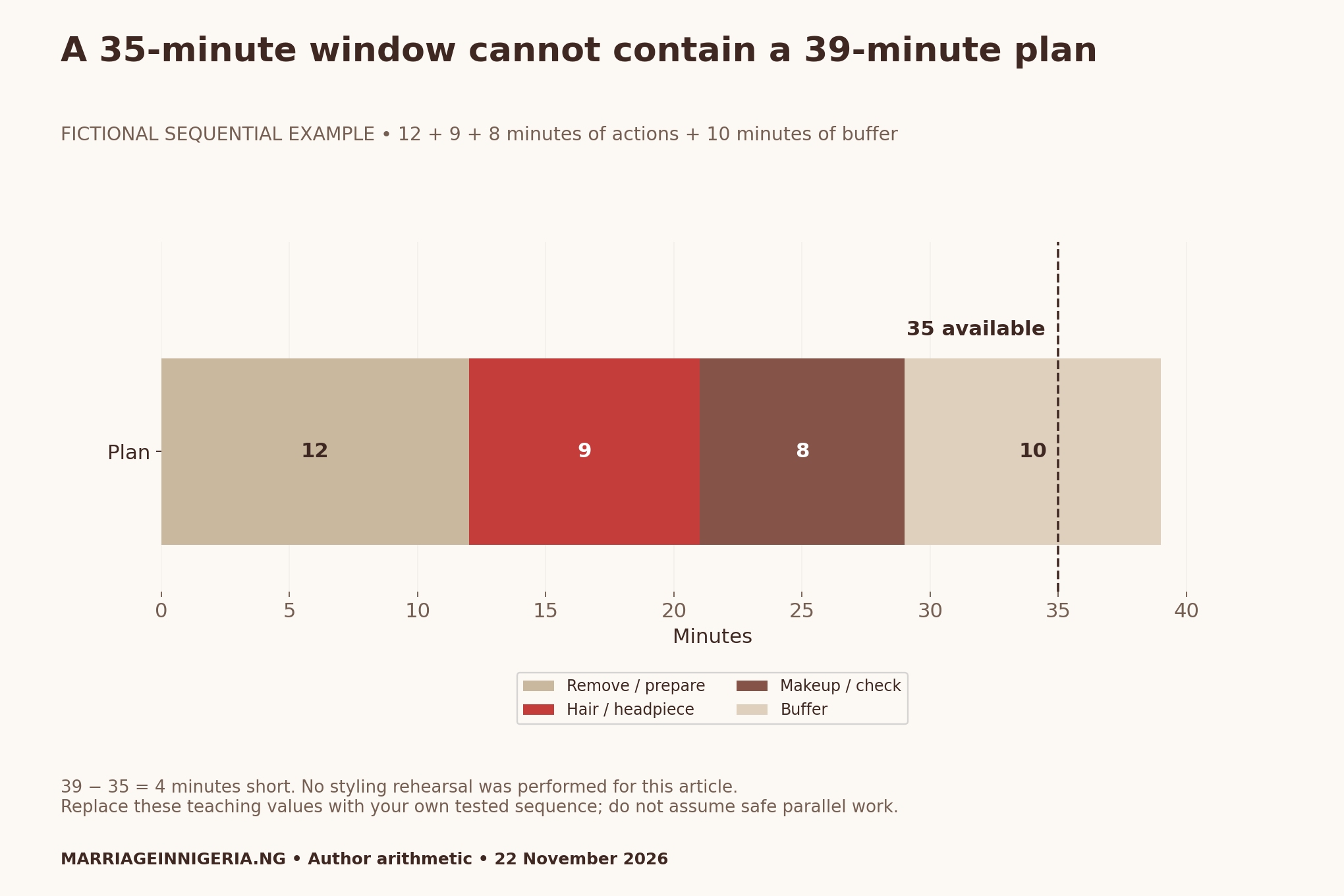
The useful number is the time your own team tests for your chosen sequence. In our fictional example, three sequential actions take 12, 9 and 8 minutes. Adding a 10-minute buffer creates a 39-minute plan for a 35-minute window: a four-minute deficit. These are teaching values, not results of a rehearsal or standard styling times.
Nigerian wedding bridal look change checklist: define the two looks
Start with a clear description of Look A and Look B. Identify the headpiece, hair arrangement, veil, jewellery and makeup finish involved. Ask the stylists what can remain and which changes depend on another action finishing first. Keep the bride’s comfort and agreed preferences central to that discussion.
Next, name the person responsible for each action. A combined package can simplify the conversation, but it does not prove that one person will perform every task. Confirm who attends, where the change happens and how the next person knows it is safe and practical to begin.
What the dated service counts can tell us
The 17 November platform snapshot lists 567 makeup selections, 489 hair selections and 382 attire/styling selections among 2,218 public original requests. Those requests were created from 10 September 2025 to 17 November 2026. Service categories can overlap.
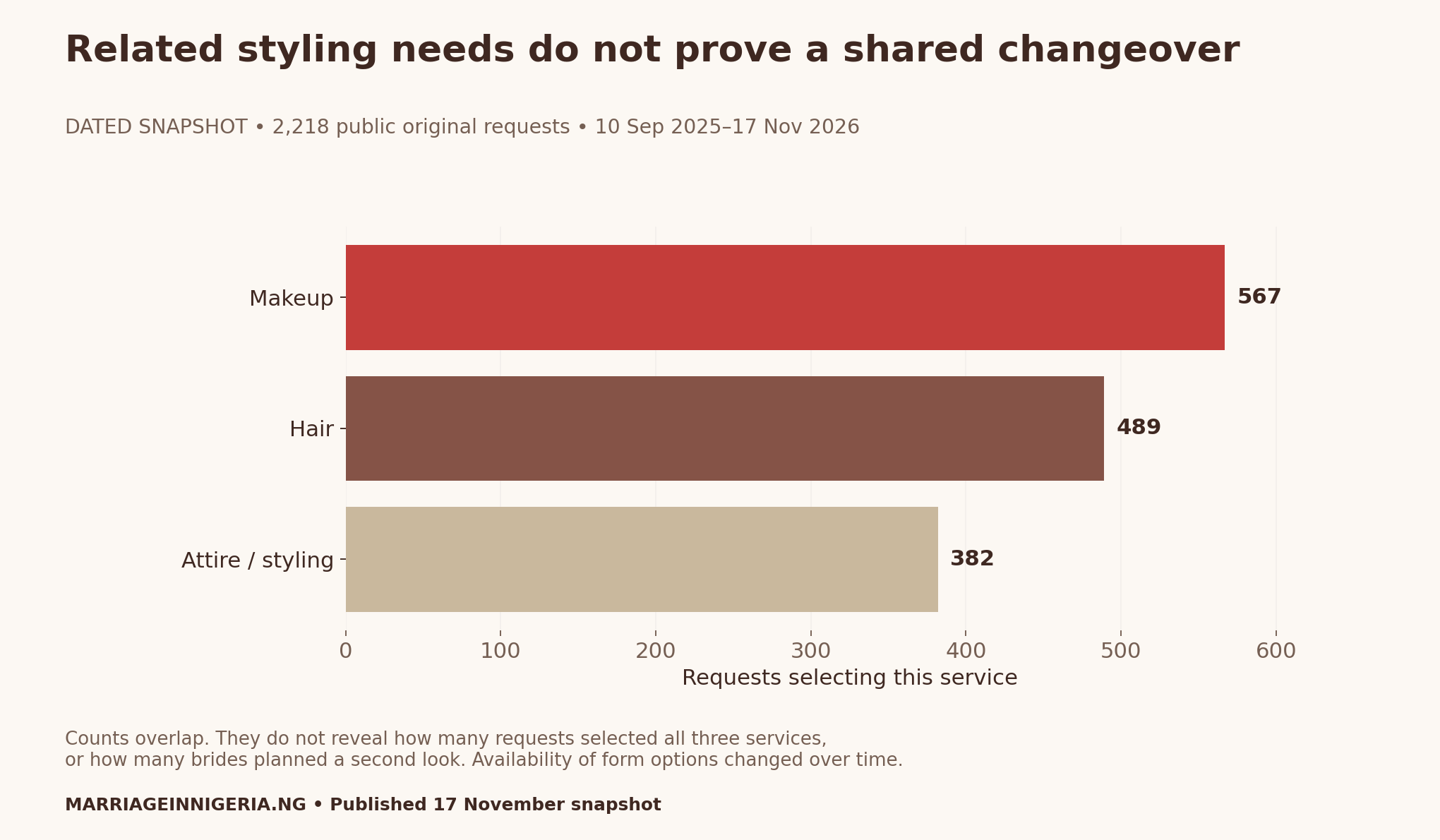
Do not add the counts and call the sum a number of brides. Also, do not infer how many people selected all three or needed a second look: the published totals do not answer those questions. Changing form availability further limits comparisons across the whole period.
As one service example, Dautouch Beauty & Bridals’ existing Lagos profile lists hair, makeup and gele together. That is a vendor-specific description, not an endorsement, an independently tested package or a promise about today’s staffing and timing. Ask any vendor to confirm the exact service you want.
Walk the handoff before timing it
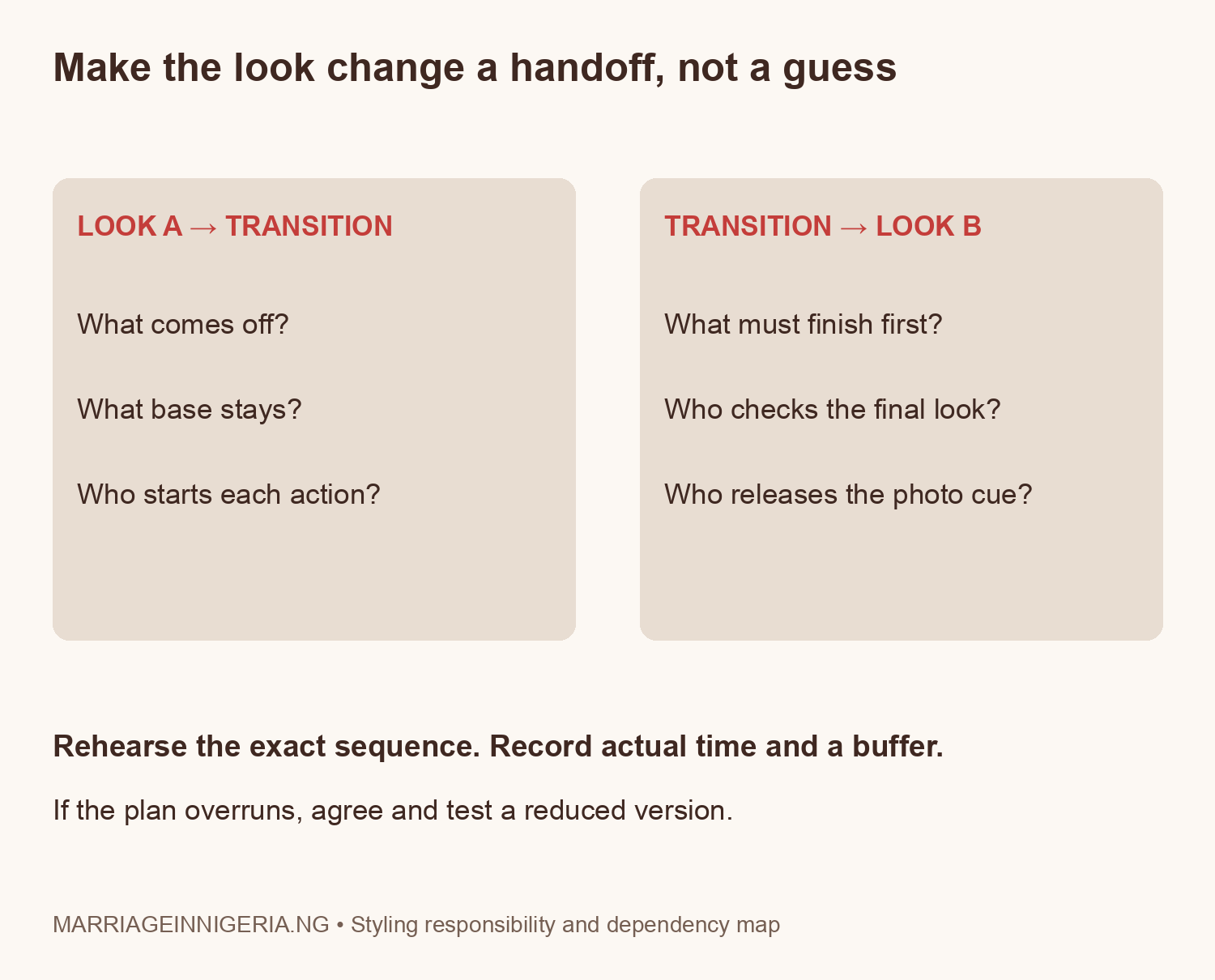
Use the rehearsal sheet to record what the first stylist removes, what the next stylist needs and who holds or stores each piece. Then identify any check that must happen before photographs or the next ceremony cue. A change is not complete simply because the last pin is in place.
For example, the agreed sequence might include removal and preparation, a hair/headpiece change and a makeup finish. Our article does not prescribe the technique or claim those actions always occur in that order. Your team should select the sequence appropriate for the real looks and the bride’s comfort.
Add the buffer to the plan, not outside it
| Fictional component | Minutes |
|---|---|
| Removal and preparation | 12 |
| Hair/headpiece transition | 9 |
| Makeup finish and check | 8 |
| Buffer | 10 |
| Total planned | 39 |
| Window available | 35 |
| Deficit | 4 |
The three actions alone total 29 minutes, which can appear to fit. However, 29 + 10 = 39 once the planned buffer is included. Consequently, the plan cannot be called a 35-minute changeover without removing time somewhere or changing the available window.
Do not solve that difference by assuming the stylists can work in parallel. Some actions may interfere with one another or need the same person. Ask the team what is feasible, agree any revised sequence and test it. A spreadsheet can reveal a conflict; it cannot certify a safe styling method.
Agree a reduced version and the last workable start
If the tested plan overruns, identify a reduced version the bride and stylists are comfortable with. Specify exactly which change is omitted or simplified, then rehearse that version. Avoid silently dropping photographs, removing the buffer or transferring the delay to another supplier.
Also, record the photographer’s cue and the last workable start against the actual event schedule. If the earlier event runs late, the named decision owner can discuss the agreed alternative. This is a narrow between-look handoff, rather than a replacement for the full wedding timeline.
For gown appointments and alterations, see our bridal fitting checklist. The look-change worksheet addresses a different decision: whether the coordinated transition works in the time actually available.
Method and downloadable rehearsal tools
We reused the published 17 November snapshot and checked the linked vendor description on 22 November 2026. We did not analyse new private requests, observe a styling session or measure a vendor’s performance. The only timing calculation is the fictional sum 12 + 9 + 8 + 10 = 39 and its four-minute excess over 35.
- Dated service-selection counts and denominator (CSV)
- Fictional look-change timing calculation (CSV)
- Blank look-transition rehearsal sheet (CSV)
- Blank timing and reduced-version agreement sheet (CSV)
Suggested citation: Marriage In Nigeria, “Bridal Look Changes: Plan the Handoff Between Your Stylists”, 22 November 2026. Keep the snapshot, overlapping-selection and fictional-timing qualifications with reused figures.


