




To confirm a wedding vendor deposit in Nigeria, match the incoming credit to the right booking through your own authorised banking record. A screenshot from a couple or family payer can help identify a claimed payment. However, it cannot independently establish that your account received the deposit.
This guide separates a provisional date hold, a payment check and a written booking confirmation. Its worked amounts are fictional. They help a vendor record uncertainty without accusing a client, confirming a date too early or asking someone to pay twice.
Confirm a wedding vendor deposit in Nigeria: start with the hold terms
First, identify the booking reference, invoice and deposit expected. Then read the terms already agreed for the provisional hold, including its expiry and who can confirm the date. Do not invent a standard hold period or describe a date as reserved merely because a payment image arrived.
If those terms were never agreed, say so clearly and resolve the booking status with the client. A register supports the conversation; it does not replace the contract or create a right to cancel. Keep the person checking receipts distinct from anyone who lacks authority to promise a booking.
Why the bank’s warning matters to a wedding vendor
UBA’s 20 November fraud-awareness guidance advises recipients to verify incoming credit in their official banking application or other authorised channel. It warns against relying on a payment screenshot alone and recommends contacting the bank through independently verified routes when something looks suspicious.
That is prevention guidance, not a study of wedding deposits. It provides no wedding-fraud rate, estimate of dishonest clients or evidence that any particular screenshot is false. We use it as the reason to check the recipient’s own record before making a booking decision.
The ₦150,000 screenshot case: keep the amount unconfirmed
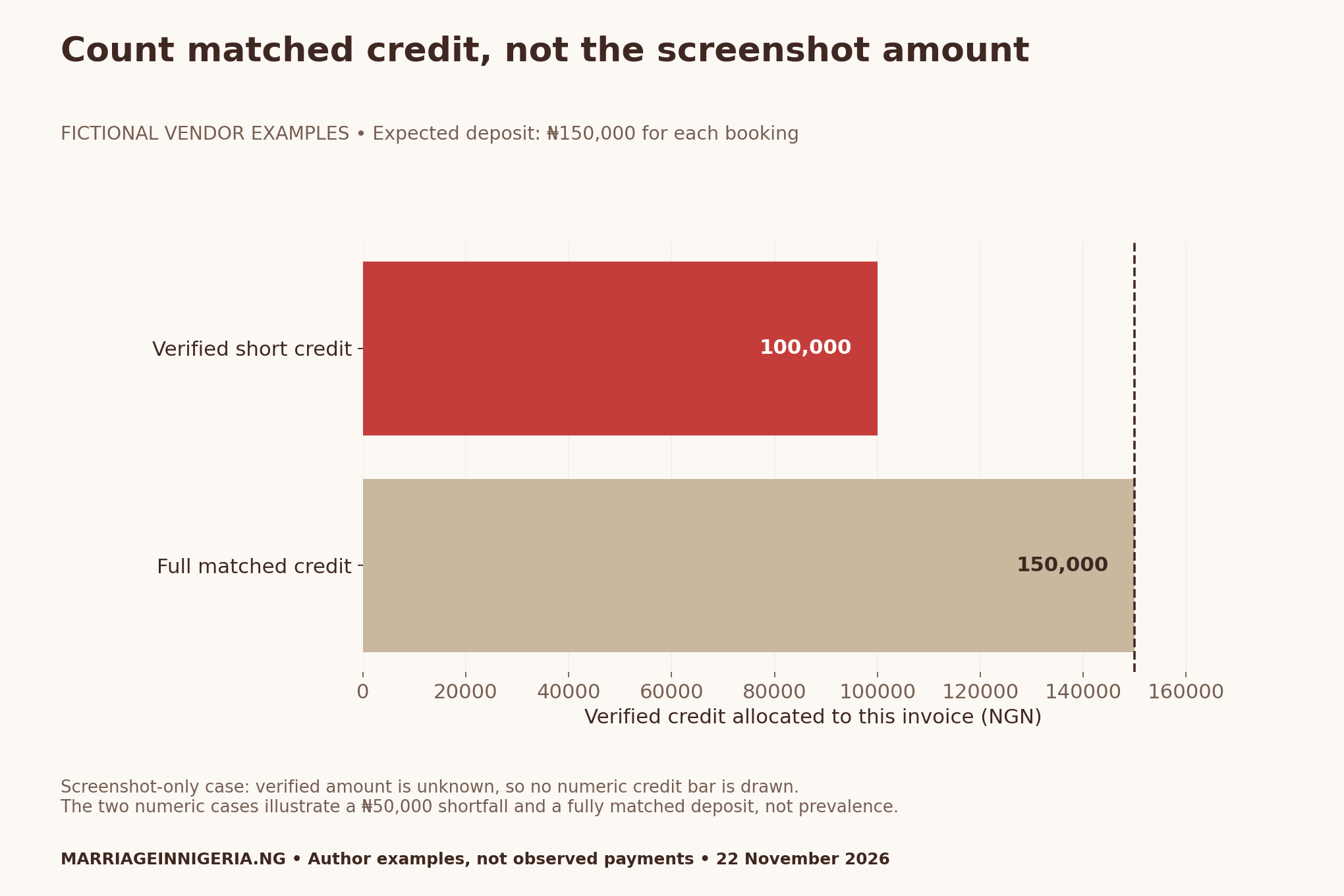
Consider a fictional booking with a ₦150,000 deposit due. A family payer sends a screenshot showing that amount, but the vendor cannot find a matching incoming credit at the time of checking. The correct register entry is “credit not yet confirmed,” with the check time and next action.
Do not convert that blank into a verified zero, a fraud allegation, a completed payment or a definite failed transfer. Several explanations may require checking. Likewise, do not tell the payer to repeat the transfer simply because the credit is not yet visible. The payer and recipient can each use their own bank’s official process to clarify the transaction.
| Fictional situation | Record | Booking action |
|---|---|---|
| Screenshot; no matched credit visible | Credit not yet confirmed | Apply agreed hold terms; arrange next check |
| ₦100,000 verified against ₦150,000 due | Verified short by ₦50,000 | Explain allocation and unresolved balance |
| ₦150,000 verified and matched | Deposit matched to this invoice | Authorised owner sends written confirmation |
Match the transaction, not just the account balance
An account balance may include unrelated credits. Therefore, locate the transaction details and compare them with the invoice, expected deposit, payer reference and booking alias. If a relative pays on the couple’s behalf, record the agreed relationship to that booking without copying unnecessary personal information.
Also distinguish a credit received from the portion allocated to this invoice. A combined transfer may cover more than one agreed item. If the reference is unclear, leave the allocation unresolved and ask a focused question. Do not use an unrelated incoming amount as evidence that this client’s date should be confirmed.
Keep the receipt owner and next update visible
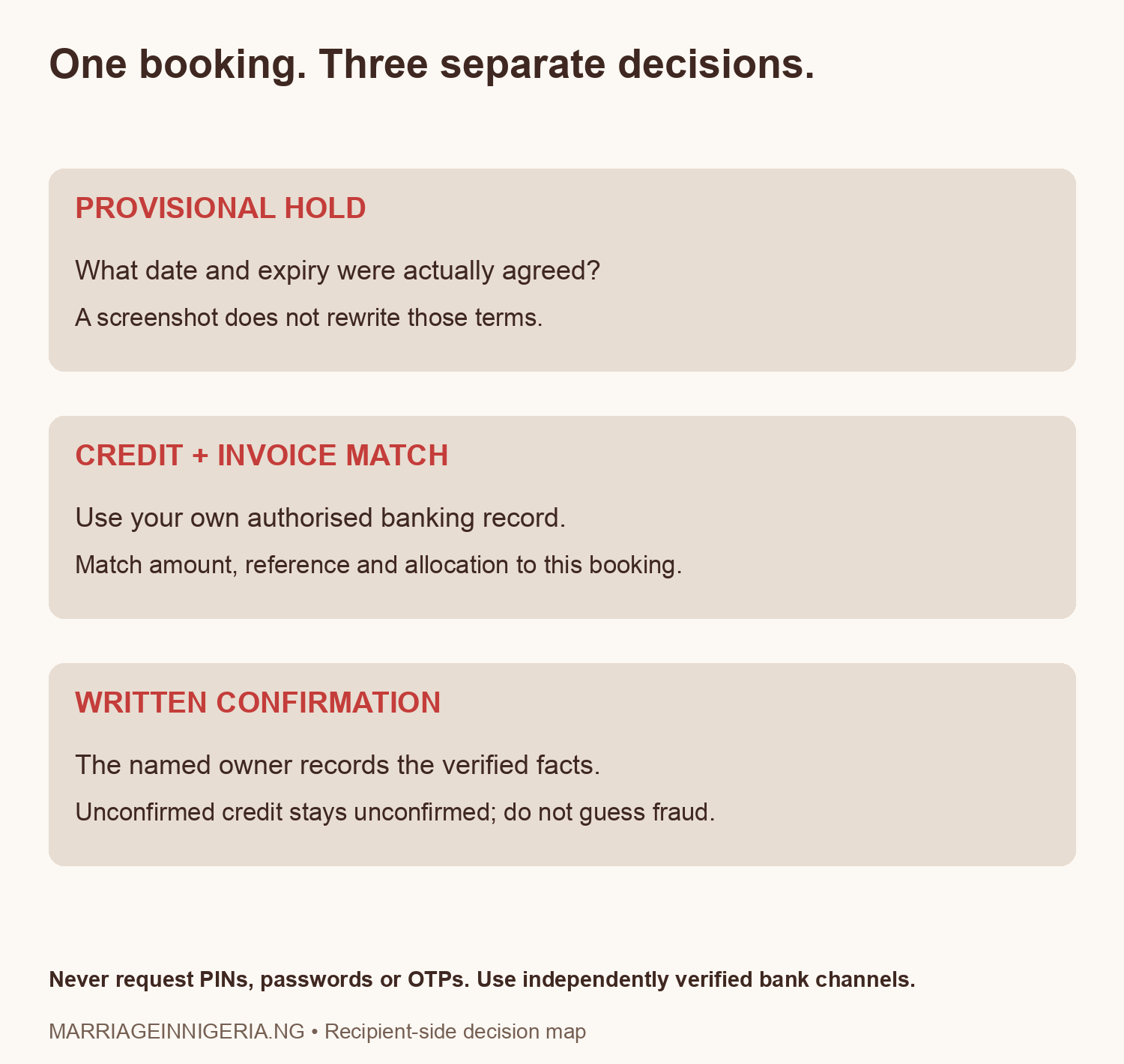
Give one authorised person responsibility for updating the register and sending the final confirmation. Record the checking time, the verified facts, what remains unknown and the next update time. This reduces conflicting messages when a planner, couple and family payer all contact the vendor.
For example, a neutral update can explain that the payment image was received but the corresponding credit has not yet been confirmed. It should refer to the existing hold terms and the next check, without promising a date or diagnosing the transfer. Avoid posting private receipts or account records in public groups.
Escalate suspicious requests through a trusted route
If someone asks for a refund, a credential or an urgent change of bank details, pause that request and contact the bank through a route you independently know is genuine. Never disclose a PIN, password or OTP. This article does not collect payment details, initiate transfers or promise recovery.
Similarly, do not refund a claimed mistaken payment on the strength of a screenshot. Ask the bank how to verify and handle the specific transaction. For the wider agreement, our wedding vendor budget guide discusses keeping payment records; the present worksheet focuses on the recipient’s date-confirmation decision.
Method, limitations and four downloads
We checked the first-party bank guidance on 22 November 2026. All amounts and booking states in the worked examples were constructed for this article; no client payments or banking accounts were tested. The numeric comparison is 150,000 − 100,000 = 50,000. It measures an illustrative shortfall, not a failure probability.
- Fictional deposit cases and next decisions (CSV)
- Deposit-check measure dictionary (CSV)
- Blank recipient-side deposit register (CSV)
- Blank booking-status update planner (CSV)
Suggested citation: Marriage In Nigeria, “Wedding Vendor Deposits: Confirm Payment Before Reserving the Date”, 22 November 2026. Keep the fictional-case and unconfirmed-credit qualifications with any reused figure.


