




Last updated: 17 November 2026. Figures are a dated platform snapshot. Live totals can change.
Wedding vendor reviews add the business side to Marriage In Nigeria’s marketplace insights. This first edition analyses 42 published vendor reviews. Their average rating is 4.17 out of 5, with 33 ratings of 4 or 5.
However, the sample has an essential boundary. The current form first asks whether a request led to a booking or a serious client conversation. Vendors who answer Yes can then add a rating and written review. Therefore, these ratings do not measure a booking conversion rate or the experience of every registered vendor.
The published reviews in this snapshot were submitted from 3 June to 3 November 2026. The data was checked on 17 November. You can read the current published vendor feedback alongside the charts below.
Wedding vendor reviews at a glance
| Measure | Published review sample |
|---|---|
| Published vendor reviews | 42 |
| Mean rating | 4.17 / 5 |
| Ratings of 4 or 5 | 33 of 42 (78.6%) |
| Highest rating: 5 | 17 reviews |
| Optional improvement text supplied | 21 reviews |
| Latest submission represented | 3 November 2026 |
First, keep the unit clear: these are published reviews. Also, a positive answer to the first question can mean either a booking or a serious conversation. The form does not separate those outcomes into a verified paid-booking count.
How the vendor form shapes the evidence
The opening question asks whether any Marriage In Nigeria client requests have led to a booking or serious client conversation. A Yes answer reveals the rating, review and optional improvement fields. By contrast, No, not yet offers a separate optional context field.
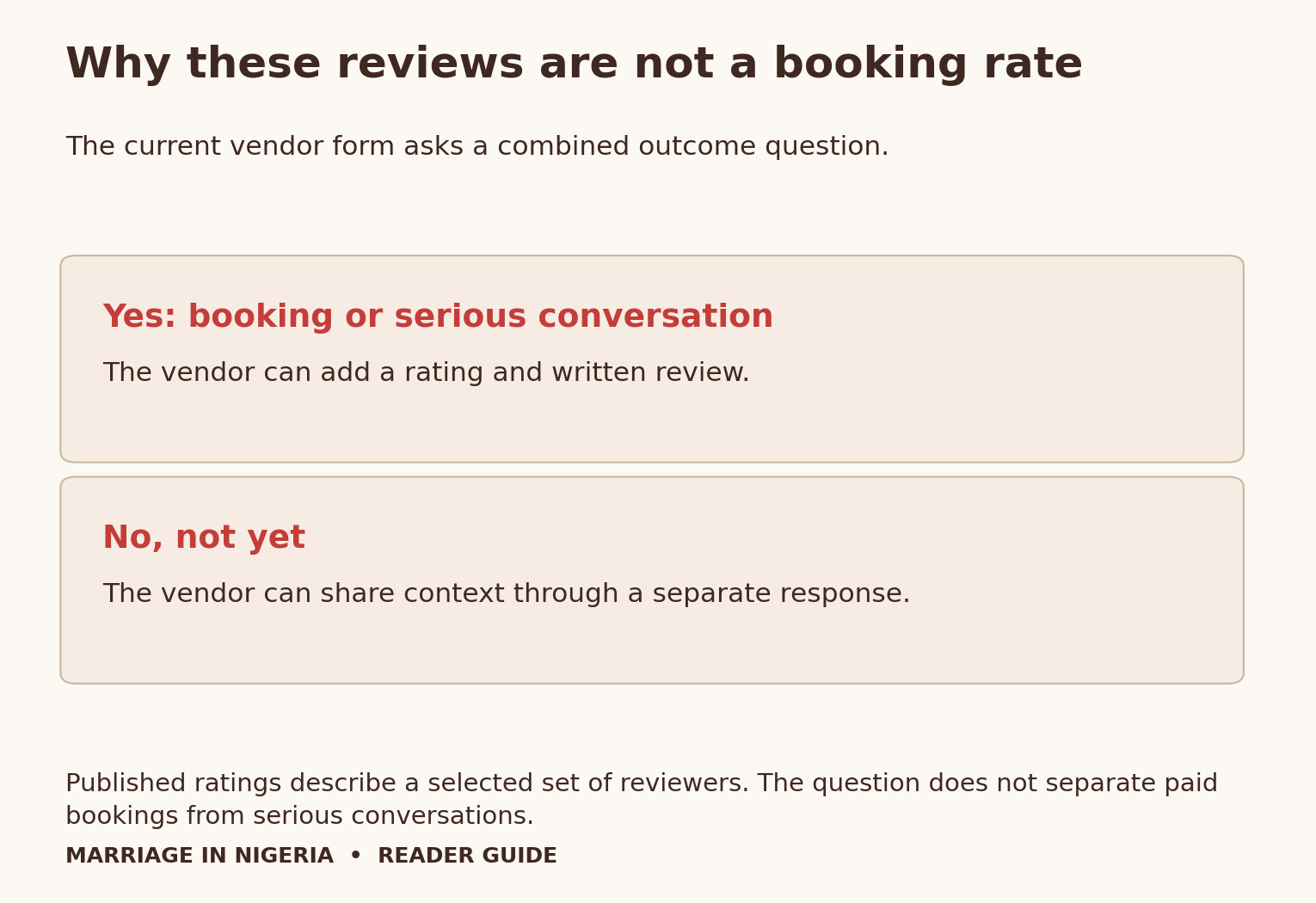
As a result, the rated sample is conditional on the affirmative outcome answer. It also passes through moderation and the public-display rules. People who have not reached that combined outcome are not represented as zero-star entries in these charts.
For example, a vendor may have a useful conversation without agreeing a price or receiving payment. Another may have a future booking that has not yet taken place. Both can fit the opening question, so neither should automatically be counted as a completed job.
The full rating distribution
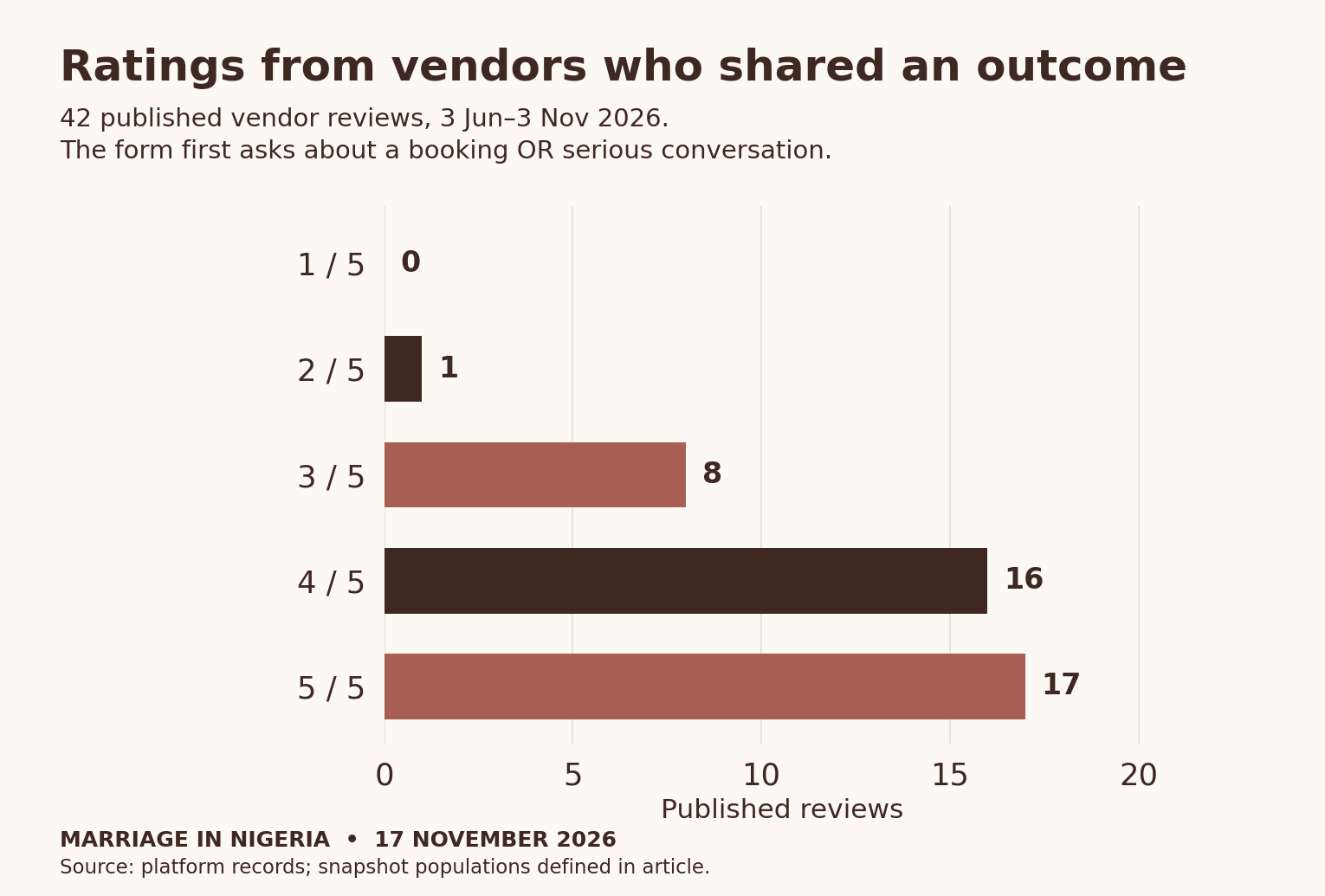
There are 17 ratings of 5 and 16 ratings of 4. Another eight reviewers choose 3, while one chooses 2. No published review in this sample has a rating of 1.
| Rating | Published reviews | Share |
|---|---|---|
| 1 / 5 | 0 | 0.0% |
| 2 / 5 | 1 | 2.4% |
| 3 / 5 | 8 | 19.0% |
| 4 / 5 | 16 | 38.1% |
| 5 / 5 | 17 | 40.5% |
Together, the two highest ratings account for 33 of 42 reviews, or 78.6%. The average is 175 rating points divided by 42, which rounds to 4.17. However, that average describes this selected published sample.
It cannot establish how all 6,512 listed profiles feel about the platform. Similarly, the absence of a rating of 1 here does not prove that no vendor has had a poor experience. Unpublished feedback, people who did not reply and the separate Not yet path fall outside this chart.
When the published reviews were submitted
September contributes the largest group with 12 published reviews. June follows with ten and October with nine. August has eight, while July has one and November has two.
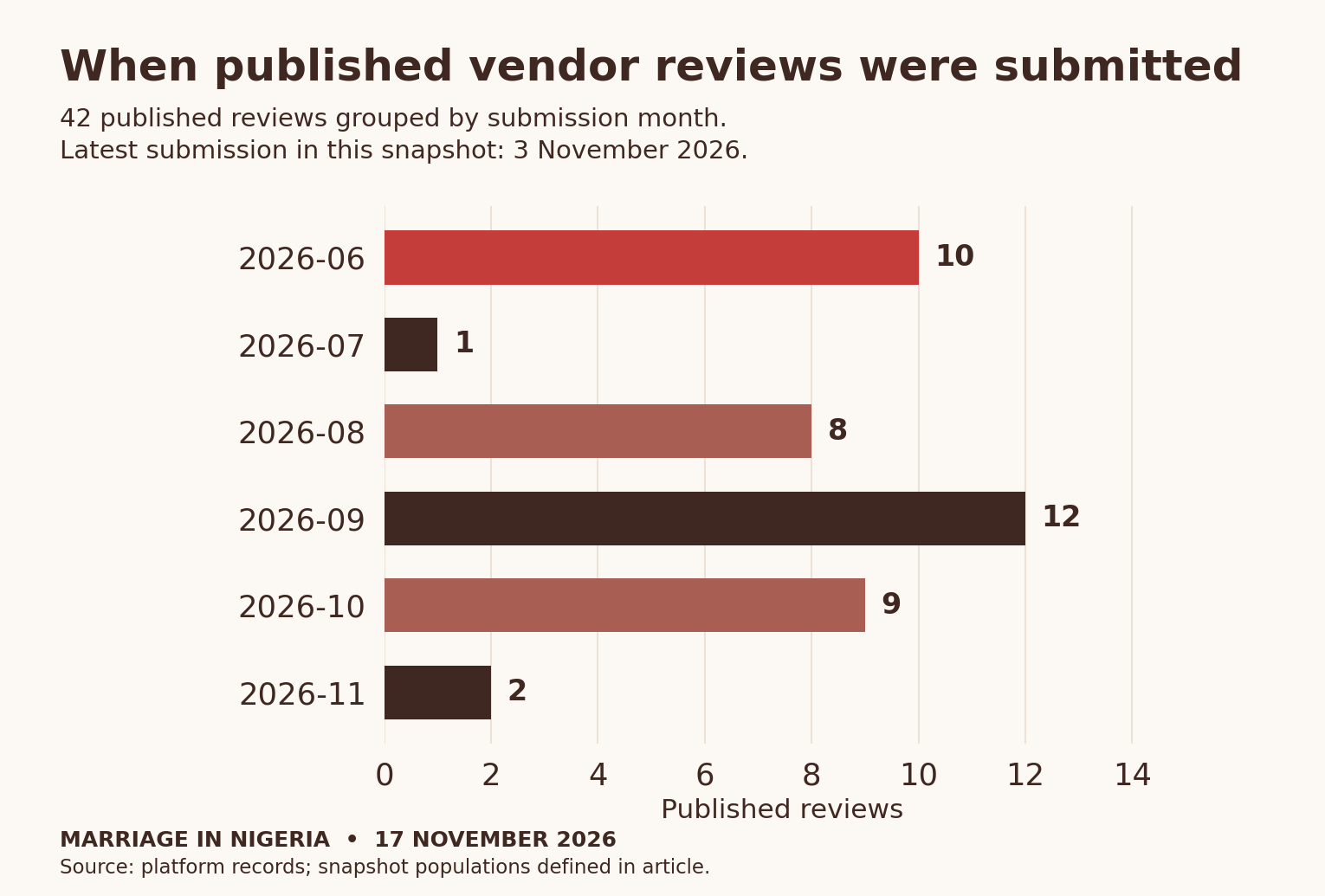
The last represented submission is 3 November, even though the snapshot date is 17 November. Therefore, the report date should not be mistaken for the date of the latest review. Also, the monthly counts do not form equal observation periods.
Invitation timing, qualification, replies and moderation can affect these counts. Consequently, a month with more published reviews is not automatically a month with more bookings or higher satisfaction. A consistent invitation and follow-up population would be needed for that analysis.
Which businesses appear in wedding vendor reviews?
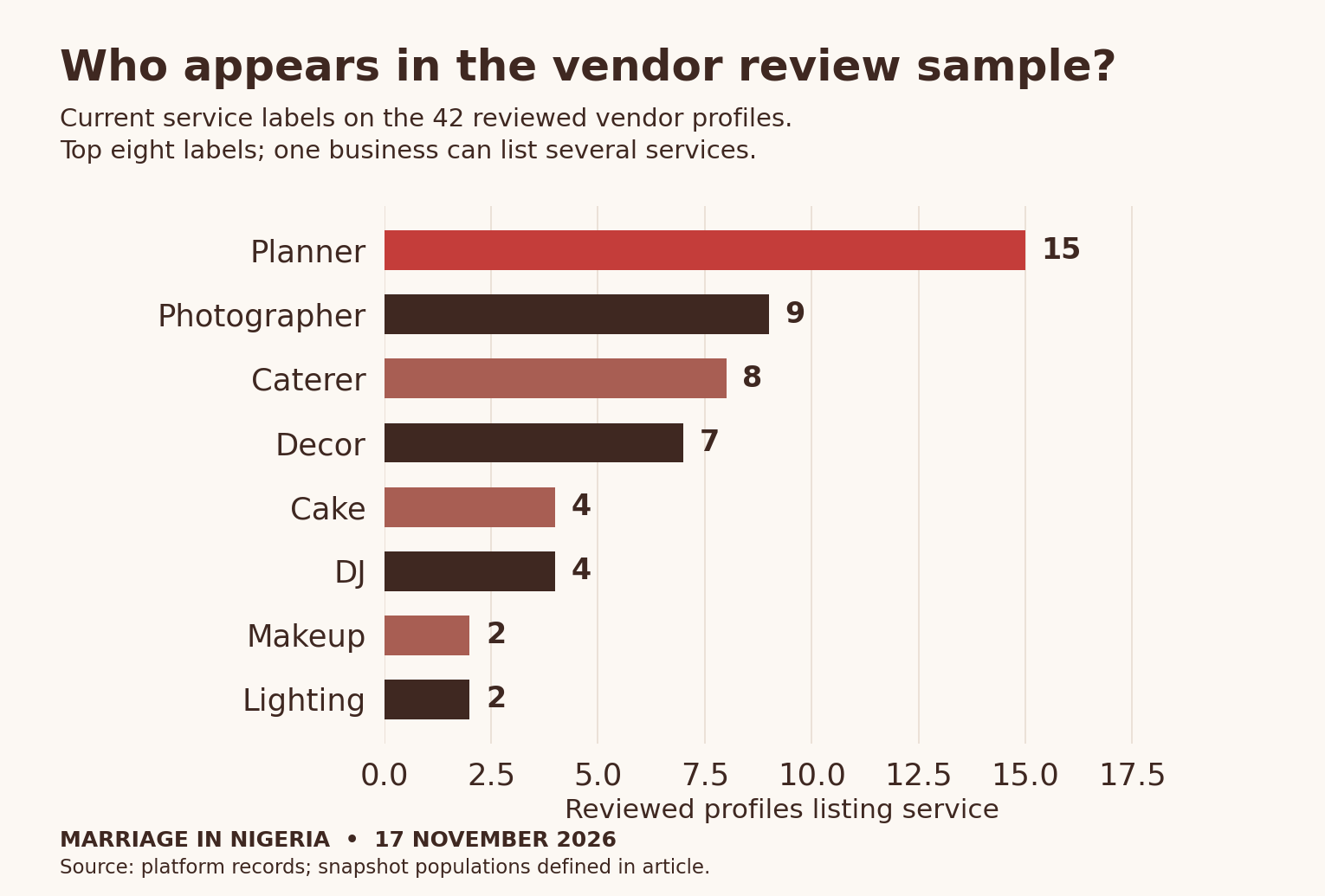
The linked vendor profiles list several service categories. Planner appears in 15 reviewed profiles, Photographer in nine, Caterer in eight and Decor in seven. Cake and DJ each appear in four.
| Current service label | Reviewed profiles listing it |
|---|---|
| Planner | 15 |
| Photographer | 9 |
| Caterer | 8 |
| Decor | 7 |
| Cake | 4 |
| DJ | 4 |
| Makeup | 2 |
| Lighting | 2 |
| MC | 2 |
| Alaga/Alaga Ijoko | 2 |
| Drinks & Bar | 1 |
| Rentals | 1 |
| Ushers | 1 |
| Band | 1 |
| Videographer | 1 |
| Security | 1 |
These labels overlap because a business can offer more than one service. Also, they describe the linked profiles at the snapshot, rather than a frozen history of every service offered when the review was written.
For that reason, service counts describe who is represented in the sample. They do not rank which categories convert best or earn the most. For example, 15 planning profiles in the sample cannot establish a planning booking rate without a suitable denominator and separately measured outcome.
What the written accounts reveal
The public accounts describe several stages of a client relationship. Some discuss completed work or future jobs. Others emphasize reaching people outside their usual area, negotiating a scope or having useful conversations.
Meanwhile, some accounts mention clients who stop replying or ask for prices without moving further. Those experiences explain why contact access, conversation and a booking should remain separate concepts. We treat them as qualitative observations rather than coded percentages.
Also, a vendor’s account is self-reported. It can show how that business understood the experience, but it does not independently verify payment, revenue or final event performance. Therefore, the report does not assign a monetary value to the stories.
Improvement suggestions add context
Twenty-one of the 42 reviews include text in the optional improvement field. That is half of the published sample. However, this is field completion, not a count of dissatisfied businesses.
A positive rating can coexist with a suggestion for clearer briefs or better conversations. Likewise, an empty optional field does not prove there was nothing to improve. Read the rating and the written account together.
For the platform, these accounts can inform clearer expectations around request readiness and contact. For vendors, they reinforce the value of checking the brief and asking relevant questions. Neither use requires pretending that every introduction will lead to paid work.
How vendors can use the findings
First, read the service, location, date and scope before choosing to pursue a request. Where a booking-stage answer is available, use it to understand the client’s current aim. For example, a person researching prices may need guidance before they can choose a provider.
Next, respond with relevant evidence and a clear next step. Explain what the proposed package includes and ask only the questions needed to assess fit. Also, respect the contact method and response deadline stated in the current brief.
Finally, track your own journey from access to conversation, proposal and booking. Those separate stages can show where your process needs work. A platform-wide rating average cannot substitute for that record.
What clients can learn from the vendor side
A clear brief helps vendors decide whether they can assist. Therefore, explain the services, venue or area, event date and priorities. If you mainly need prices for planning, say so directly rather than implying that a booking decision is immediate.
Also, compare proposals on the same scope. A lower total may cover fewer hours, fewer people or different deliverables. Once you choose a provider, agree the service and payment terms directly and keep the written record.
Methodology and limits
This edition counts active, approved vendor reviews that meet the public permission rules. Each included review has non-empty review text and links to an active directory profile with a public profile destination. The resulting sample contains 42 reviews.
We use recorded submission dates and ratings from 1 to 5. The average is the arithmetic mean. For services, we count each recognized current label once on each included profile; multiple labels can overlap.
Why this is not a conversion or response rate
The rated form follows a combined booking-or-serious-conversation answer. It does not independently separate bookings from conversations, verify amounts paid or provide a complete invitation denominator. Therefore, we do not calculate a booking conversion rate, earnings estimate or response rate from these reviews.
Also, the published sample is selected by eligibility, participation, moderation and public-display permissions. It cannot represent all vendors, all platform users or Nigeria’s wedding industry. Private contact details, unpublished accounts and precise addresses are outside this article.
Read the marketplace from both sides
Wedding vendor reviews describe a different journey from client request reviews. Their questions and selection rules differ, so the two averages should not be treated as competing scores for equivalent populations.
For more context, explore the vendor landscape, demand trends and supply and demand comparison. You can then use the current directory or read the current access options with realistic expectations.
Suggested citation: Marriage In Nigeria, “Wedding Vendor Reviews: Live Feedback From Marriage In Nigeria,” 17 November 2026. Include the snapshot date when citing the figures.