




Choosing a bilingual Alaga for a Yoruba wedding involves more than asking which languages they speak. Before booking, ask for one focused demonstration using a segment the relevant families and practising Alaga have approved. Check whether the handoff keeps the intended meaning clear and tells mixed-language guests what to do next.
This guide provides an audition card and feedback rubric. It does not supply ritual wording, describe one universal Yoruba ceremony or claim that an audition has already taken place. The families and practitioner should decide which material is appropriate to demonstrate, interpret, record or keep private.
Bilingual Alaga for a Yoruba wedding: choose one specific handoff
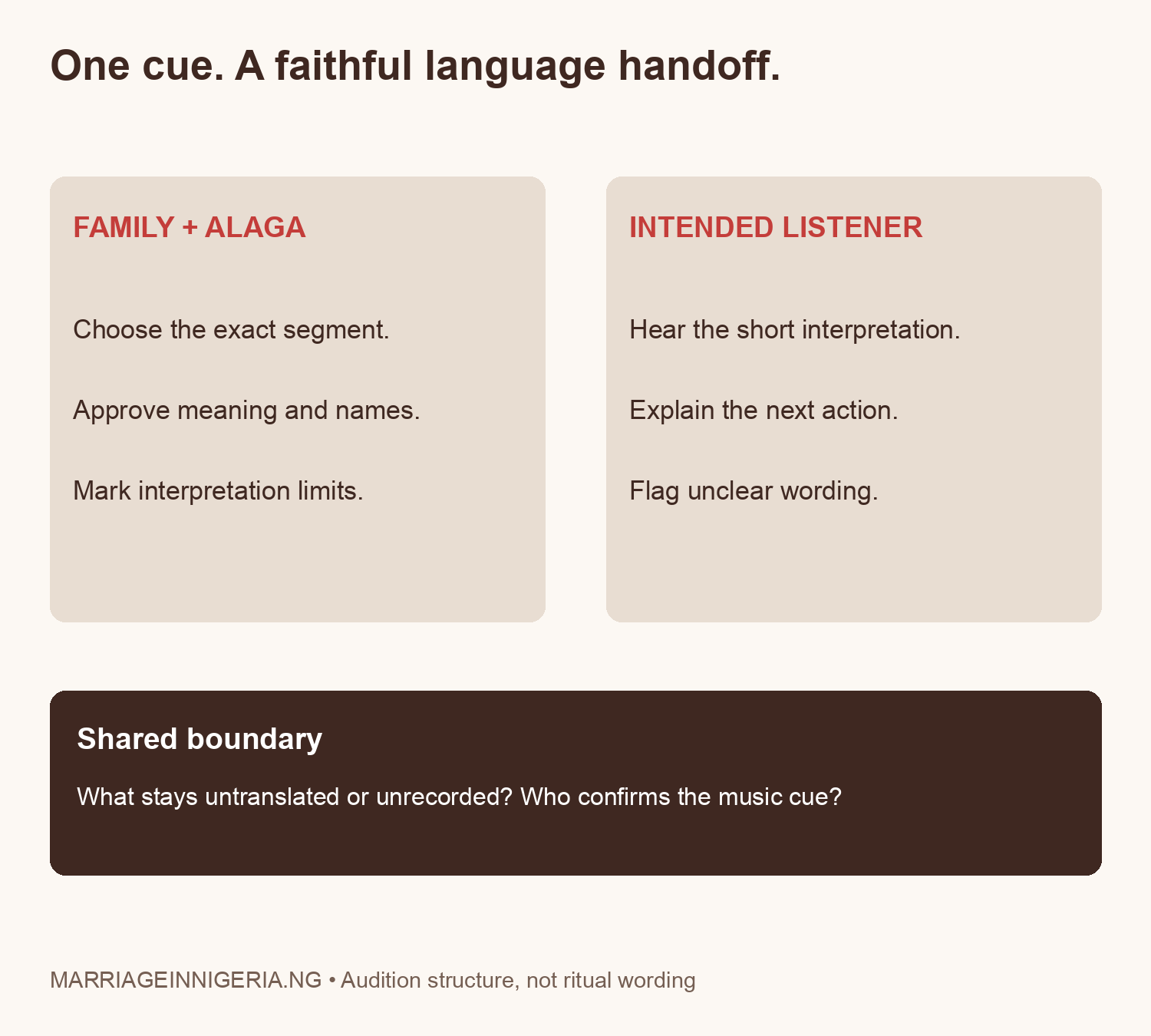
Start with a small segment rather than a full event performance. Give it an alias on the worksheet, then identify the lead cue, intended audience and action guests need to understand. Ask the relevant family representatives and Alaga to agree the purpose before preparing any wording.
Keep the original wording and short interpretation as separate references. This makes it easier to see what an explanation adds, leaves out or changes. If the families have not approved the wording, leave that field blank. Do not turn a generic online example into an instruction for their ceremony.
What the platform’s 277 requests actually count
The 17 November demand snapshot records Alaga/Alaga Ijoko in 277 of 2,218 public original requests, or 12.5% rounded to one decimal place. The requests were created from 10 September 2025 to 17 November 2026.
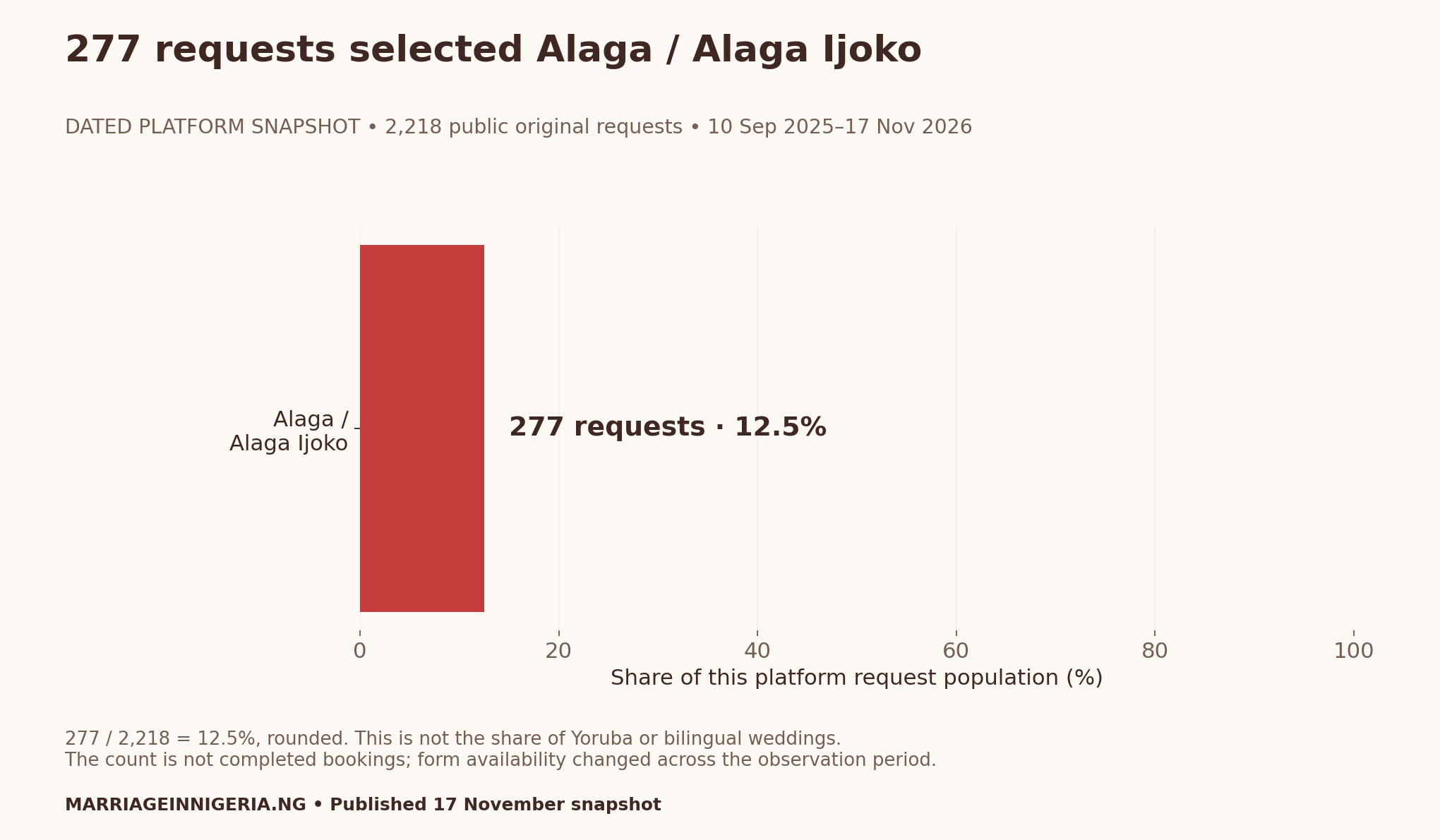
The count supports topic relevance, but it cannot tell us how many events were Yoruba, bilingual or completed. Service choices can overlap, and the form’s category availability changed during the period. Therefore, this cumulative share should not rank cultural practices or measure an Alaga’s performance.
One existing Blossom Alaga profile describes Yoruba–English interpretation. Treat that as a vendor-specific service description, rather than independent verification of an audition or a recommendation. Confirm the actual practitioner, scope and availability directly when making an enquiry.
Agree interpretation and recording boundaries first
Ask the families and practitioner what should be explained, what should remain untranslated and what should not be recorded. These are separate decisions. Permission to interpret a cue for guests does not automatically mean permission to publish a recording on social media.
Record a named confirmer for each open question. For example, one family representative may clarify a name while another person confirms a particular instruction. Do not assume that a vendor, planner or guest can approve every family’s wording. Keep any sensitive rehearsal material in the agreed private channel.
Use a rubric that records feedback rather than invented scores
| Check | What to ask during the agreed demonstration |
|---|---|
| Names and pronunciation | Did the relevant person confirm the names and corrections? |
| Guest action comprehension | Can the intended listener explain the next action? |
| Faithful handoff | Does the short interpretation retain the approved meaning? |
| Boundaries | Were untranslated and unrecorded limits acknowledged? |
| Music cue | Who signals the DJ, and what starts or stops the music? |
First, ask the named confirmer to identify any pronunciation change. Then ask an intended listener to explain the action in their own words. Finally, compare that understanding with the family-approved purpose. A confident delivery can still leave a cue unclear, so record the specific point to change.
Avoid a numerical “culture score” or a pass mark invented from this worksheet. A useful outcome is a concrete revision with an owner and, where needed, another demonstration. Feedback from one segment or listener should not become a claim that every guest will understand the whole ceremony.
Keep the DJ handoff narrow and explicit
Add the agreed music cue to the same card. Identify who gives the signal, what the DJ should do and who confirms that the spoken handoff is complete. This helps reveal an unresolved dependency without expanding the audition into a full wedding schedule.
If the cue or interpretation changes, update the shared version and ask the responsible people to acknowledge it. Do not assume an earlier recording still reflects the final agreement. Also, keep the distinction between an audition, a quotation and a signed service booking clear.
Resolve the changes before making the booking decision
Use the feedback register to list what remains unresolved and who should answer. The couple can then discuss those points with the vendor before committing. The worksheet supports a focused conversation; it does not guarantee cultural fit, guest comprehension or event performance.
Our cultural-sensitivity guide covers broader coordination. This article stays with one decision: whether a proposed bilingual handoff can be demonstrated faithfully within the boundaries the relevant families set.
Method and four downloadable tools
We reused the published 17 November platform snapshot and checked the linked profile on 22 November 2026. No new private requests were analysed, no families or Alaga were consulted for this article, and no audition was performed. Consult the relevant families and a practising Alaga before filling or publishing ceremony wording.
- Dated Alaga selection count and denominator (CSV)
- Proposed audition checks and evidence boundaries (CSV)
- Blank family and Alaga audition card (CSV)
- Blank audition feedback and revision register (CSV)
Suggested citation: Marriage In Nigeria, “Booking an Alaga: Test the Bilingual Ceremony Handoff”, 22 November 2026. Keep the platform-population and proposed-rubric qualifications with reused figures.


