





Bridal styling packages need an itemized scope before you compare the headline amounts. A stylist may design, make, supply, rent or source different pieces. However, the package name alone cannot tell you who pays for the outfit or whether you keep the accessories. Map those responsibilities first.
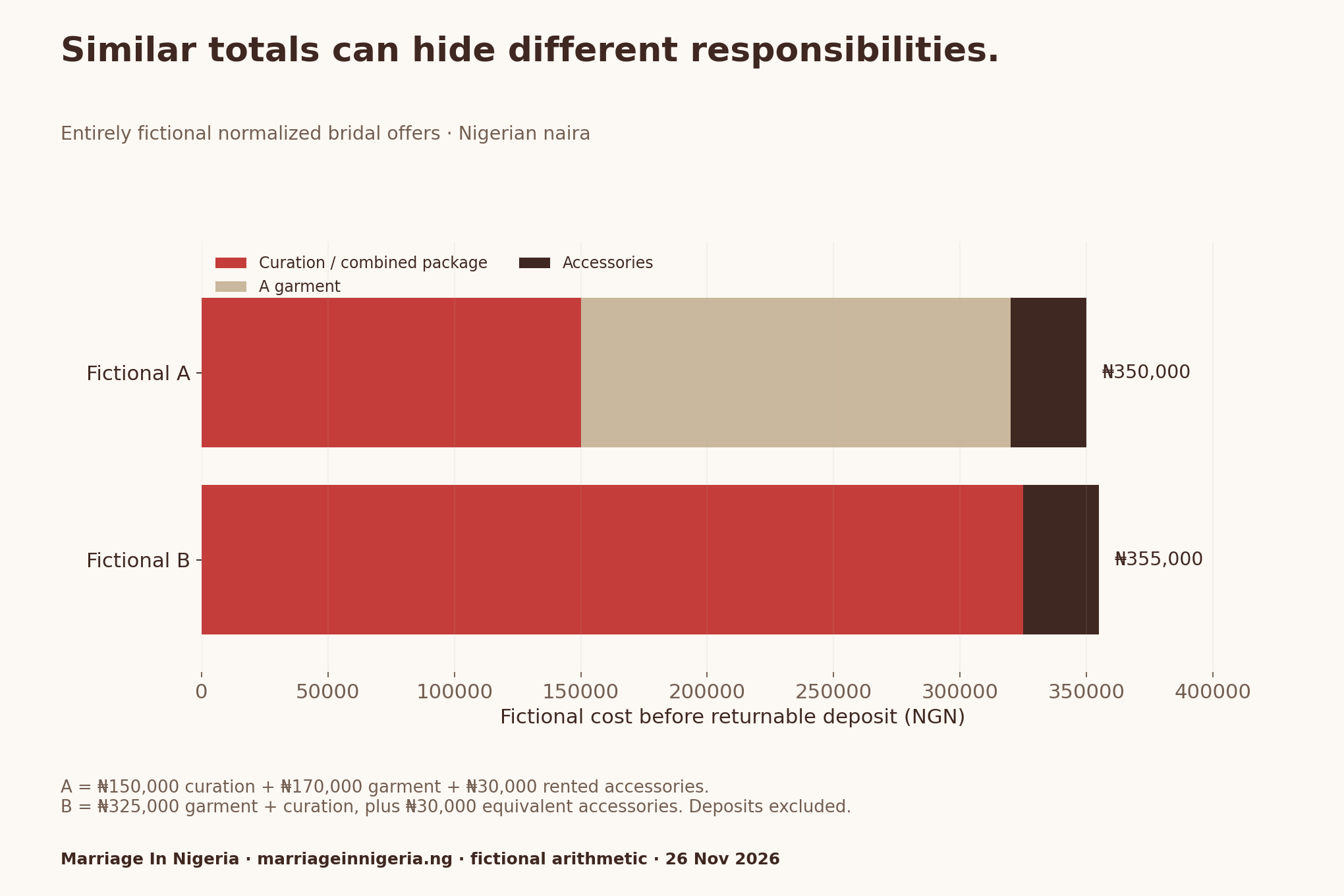
Our entirely fictional comparison totals ₦350,000 for Offer A and ₦355,000 for Offer B before any returnable deposit. The small ₦5,000 difference does not settle which order fits your needs. One chart, an ownership infographic and four CSV tools separate goods, service fees, payment and returns.
Why bridal styling packages need more detail
A combined white and traditional wedding request published on 25 November 2026 selected the broad Attire & Styling service. That is evidence of a stated service need, not an itemized wardrobe order. It does not show which garments, accessories or production services any supplier agreed to provide.
We checked the current request form and its active service selections. A broad category can start a conversation, but the accepted supplier scope must answer the item-level questions. Also, we do not reproduce the requester’s name, identifying venue information or contact details. The fictional offers below are unrelated to that requester’s budget.
My Kind of Style’s bridal form distinguishes garment production from options that add gele coordination, accessories styling or a fuller styling experience. Its form also asks who provides fabrics. These are that atelier’s choices, not evidence that all Nigerian packages use the same inclusions.
Zeebah Signature’s own FAQ and service terms distinguish styling arrangements and a specific on-site couture service. For the latter, it describes retrieving fabrics and excluding a photographer, hairstylist, makeup artist and location. Those conditions belong to that described service. Do not apply them to every outfit, every Zeebah order or another vendor’s package.
Separate the service from the physical goods
First, ask what the service fee buys: concept direction, sourcing, production, coordination, fittings or event-day assistance. Then list the physical items separately. Record each garment, fabric, head covering, accessory and shoe that matters to the agreed look. A recommendation is not proof that the stylist supplies the item.
Next, name the supplier and payer for each piece. For example, the stylist may suggest an accessory while a separate rental business invoices you. Alternatively, the main quote may include that accessory. Keep the actual arrangement visible rather than counting the same item twice or assuming it costs nothing.
Also distinguish ownership from possession on the wedding day. Ask whether you buy, rent or borrow the piece, who holds any deposit and when a return is due. Confirm the condition check, cleaning terms and any late-return charge. Leave unanswered questions open instead of treating silence as permission to keep an item.
Normalize a fictional pair of offers
In invented Offer A, curation costs ₦150,000, the garment costs ₦170,000 and rented accessories cost ₦30,000. The combined amount is therefore ₦350,000 before any returnable deposit. The example assumes equivalent agreed pieces and excludes unspecified delivery, alteration or deposit amounts.
In invented Offer B, the garment and curation together cost ₦325,000. Add ₦30,000 for equivalent accessories to reach ₦355,000. We do not infer how B divides its combined fee. Similarly, we do not infer ownership or return terms from the total. Confirm those terms in the actual order.
| Fictional comparison | Offer A | Offer B |
|---|---|---|
| Curation and garment | ₦150,000 + ₦170,000 | ₦325,000 combined |
| Equivalent accessories | ₦30,000 rental | ₦30,000; confirm terms |
| Total before deposit | ₦350,000 | ₦355,000 |
| Ownership and returns | Itemized confirmation needed | Itemized confirmation needed |
As a result, compare the full scope alongside the total. A similar amount can cover a different number of appointments, a different alteration arrangement or a different ownership outcome. If an important item remains unconfirmed, ask for a revised quote before deciding that the offers are equivalent.
Use an ownership matrix for every piece
The matrix assigns each item a supplier, payer and keep-or-return outcome. It also gives alterations and unavailable items an owner. Therefore, it works across a multi-vendor wardrobe without assuming that the stylist does every task. Use the accepted item description, rather than a mood-board image, as your order reference.
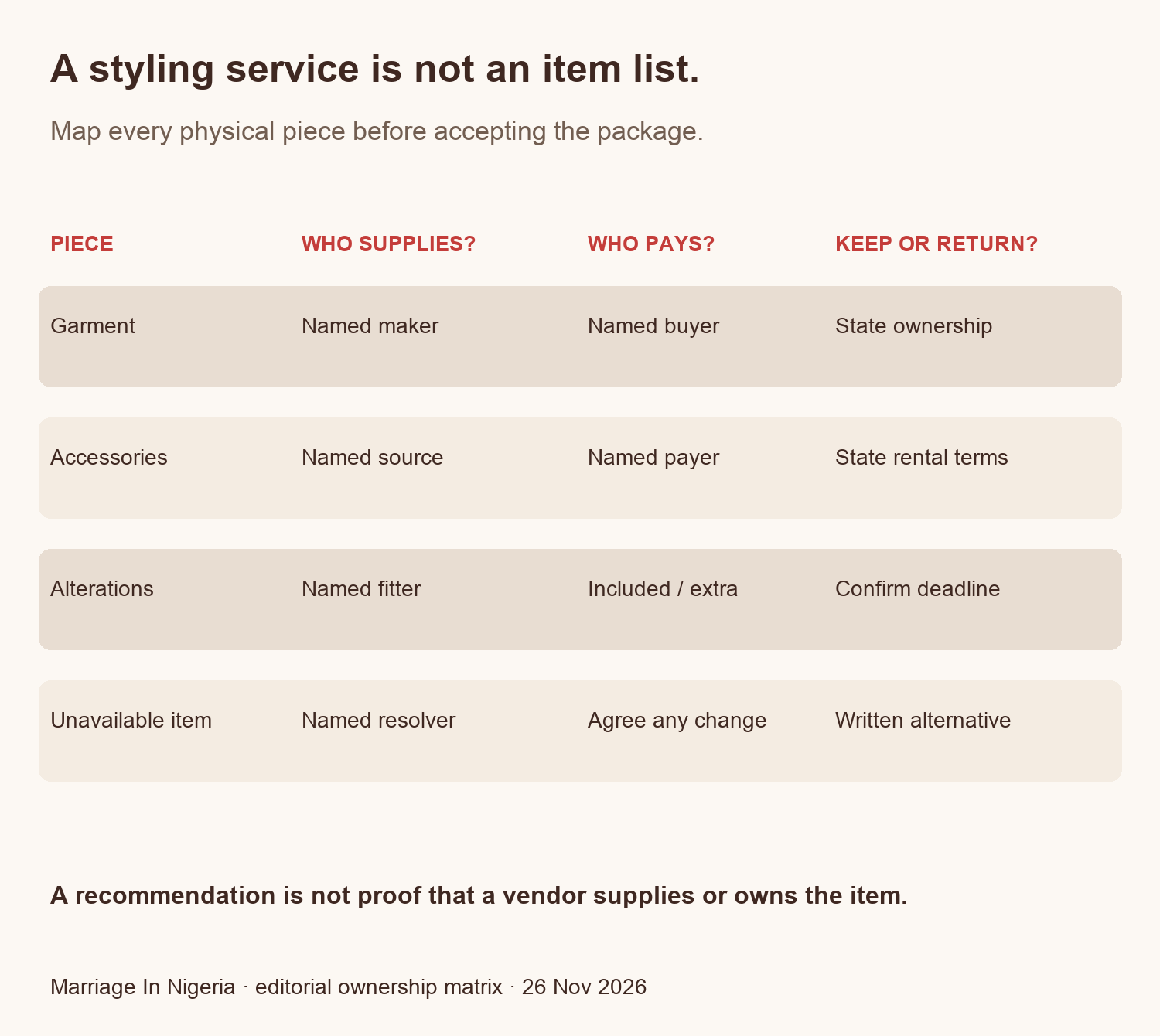
For alterations, agree which fittings and changes the fee includes, who approves the final fit and when extra charges need approval. For rented pieces, confirm pickup and return dates separately from the event date. Also identify who handles transport and any condition evidence required at handover.
If an item becomes unavailable, require an agreed alternative rather than an automatic substitution. Record the replacement specification, any price change and who accepts it. Then update the same written scope so the invoice, fitting plan and accessory return list all refer to the current version.
Get the itemized order before paying
Finally, request one accepted summary of the goods and services, even if several suppliers issue invoices. Include the looks, fabrics, supplier, payer, appointments, hours, exclusions and return terms. Keep optional extras separate. This makes a change easier to review without confusing it with the original package.
For the next stage, our bridal fitting checklist addresses preparation for fittings. Our outfit-change handoff guide addresses event-day coordination. This report instead focuses on pre-booking package scope and ownership.
Download the scope and ownership tools
The source file records the limits of the provider examples. The fictional cost file reproduces the chart. Fill the blank ownership matrix and written-scope sheet with your supplier’s actual accepted terms. A blank amount means unknown, not free, and no template substitutes for the supplier’s confirmation.
- Fictional normalized bridal offer costs (CSV)
- Provider service-scope source observations (CSV)
- Blank bridal item ownership matrix (CSV)
- Blank itemized styling scope (CSV)
Method and limits: checked on 26 November 2026. A = 150,000 + 170,000 + 30,000 = 350,000. B = 325,000 + 30,000 = 355,000. Difference = 5,000 before unspecified deposits or extras. One public request provides the fresh editorial lead. Provider-specific descriptions illustrate scope differences; no package prevalence, standard inclusion or market price is inferred. One substantive cost chart avoids filler figures.
Suggested citation: Marriage In Nigeria, “Bridal Styling Packages: Does Your Quote Include the Outfit?”, 26 November 2026. Keep the fictional amounts and ownership qualifications with reused figures.