






Wedding vendor date change terms should be clear before you pay for a date that may move. Asking about availability, holding a date and confirming a booking are different states. A later transfer needs accepted terms. Therefore, confirm the new date, scope, carried payment, fee and balance in writing.
Our entirely fictional example carries ₦100,000 already paid into a ₦300,000 booking and adds an agreed ₦15,000 change fee, with no repricing. The revised total is ₦315,000 and the remaining balance is ₦215,000. A chart, decision tree and four CSV tools explain that conditional calculation. This is general information, not advice on a particular dispute.
Why a wedding vendor date change needs explicit agreement
A public wedding request published on 25 November 2026 marked its event date flexible. That is a requester’s planning preference, not proof that a supplier held either date or accepted a transfer. No booking agreement or payment record was supplied for this article.
We checked the current request form’s flexible-date option. It describes uncertainty in the brief; it does not create supplier availability or payment terms. Also, we do not reproduce requester names, identifying venue details or contact data. The fictional booking below is separate from that request and its budget.
Distinguish a hold, a booking and a requested change
First, ask whether the supplier is discussing availability, offering a temporary hold or accepting a confirmed booking. If the supplier offers a hold, request its expiry and conditions. Do not assume that a conversation reserves every date you mention. Save the version both parties actually accept.
Next, identify the existing booking before proposing a change. State the current date and agreed scope, then name the requested new date. Ask the supplier to confirm availability for that specific date and service. Until the supplier accepts, label the transfer unconfirmed rather than updating the plan as though it is complete.
Also ask what happens to the amount already paid. It may be subject to agreed credit, a stated change charge, repricing or a separate cancellation discussion. The payment itself does not answer those questions. Obtain the proposed terms and reconcile them before agreeing to another payment.
Cancellation guidance is different from an agreed transfer
FCCPA section 120 addresses cancelling advance bookings, reservations or orders, subject to reasonable cancellation charges. Fairness depends on the circumstances, including the service, notice, potential replacement customer and industry practice. Section 120(3) excludes a cancellation fee where death or hospitalisation of the person benefiting from the booking prevents its fulfilment. The FCCPC’s consumer-rights summary provides public guidance on cancellation and refunds.
That cancellation framework does not itself confirm a vendor’s availability on another date or the terms of a mutually agreed transfer. Likewise, do not assume an automatic full refund in every cancellation or treat every requested fee as valid. For a disputed case, seek case-specific guidance from the FCCPC or a qualified Nigerian lawyer.
The practical distinction matters when drafting a message. A request to move a booking should ask for a revised agreement. A cancellation should identify that separate decision and the applicable circumstances. Keep the supplier’s answer and any itemized charge; do not silently substitute one route for the other.
Reconcile an entirely fictional transfer
Suppose an original quote totals ₦300,000 and the client has paid ₦100,000. Both parties accept a new date, carry the full ₦100,000 forward and agree a ₦15,000 change fee. The example assumes unchanged service scope, no repricing and no other charge. These are invented terms, not a standard vendor policy.
The revised total is ₦300,000 + ₦15,000 = ₦315,000. Subtract the agreed ₦100,000 credit to get ₦215,000 still to pay. The credit is money already paid, not a new payment or a refund. Therefore, do not add the original deposit again when calculating total spending.
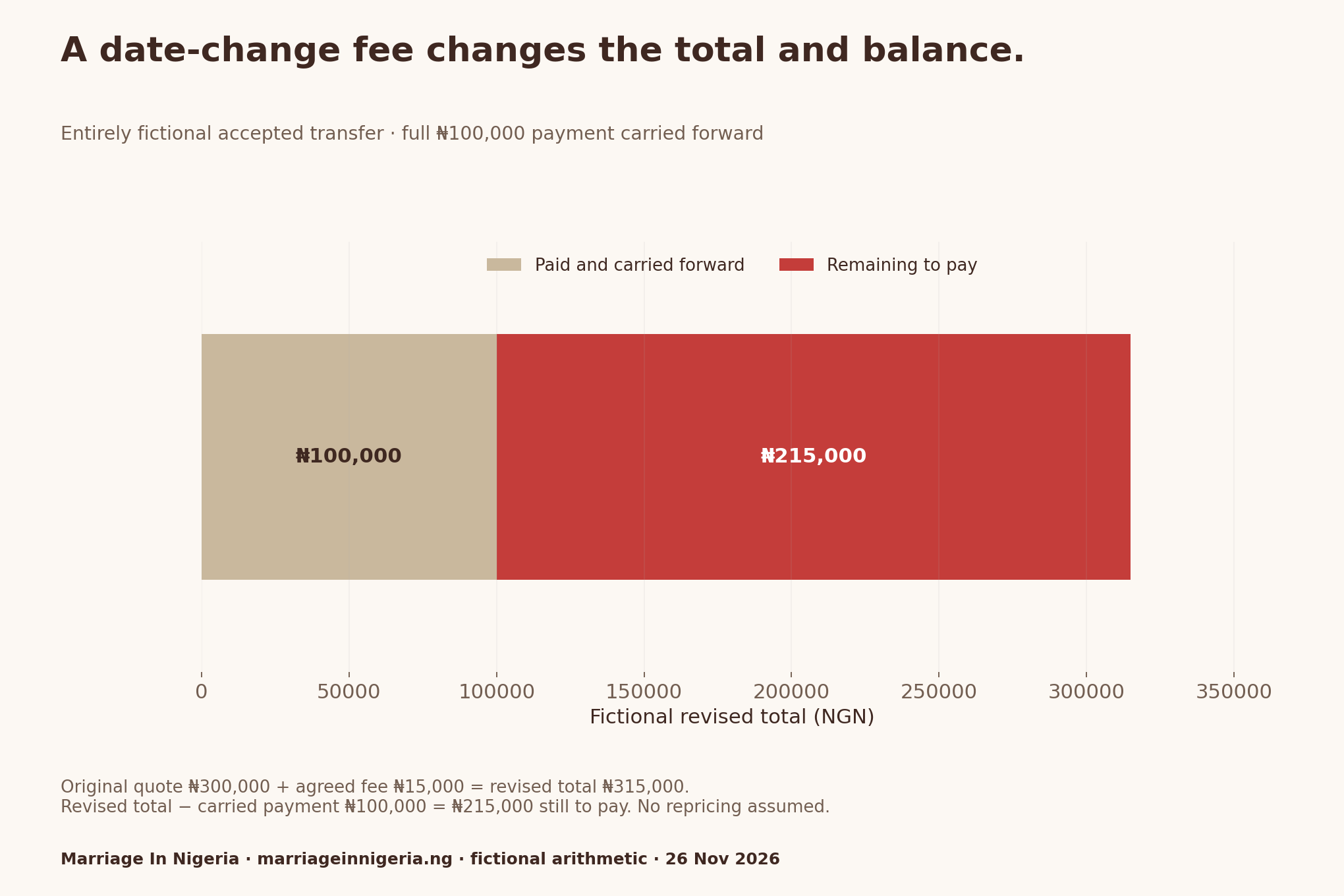
| Fictional item | Amount | Meaning |
|---|---|---|
| Original quote | ₦300,000 | Existing assumed service price |
| Agreed change fee | ₦15,000 | Additional synthetic charge |
| Revised total | ₦315,000 | Quote plus fee |
| Agreed payment carried forward | ₦100,000 | Already paid; not new cash |
| Remaining balance | ₦215,000 | Revised total minus credit |
If the supplier proposes a different credit or revised price, replace the assumptions with those terms before calculating the balance. However, an arithmetic result does not decide whether a charge is fair or enforceable. Keep the financial reconciliation separate from any legal dispute about the terms.
Use a decision tree before changing the plan
If the vendor accepts the new date and the transfer terms, record the current scope, credit, fee, total and payment dates together. When availability remains uncertain, leave the change pending and ask about alternatives. Alternatively, if the parties discuss cancellation, handle that route separately with the relevant consumer guidance.
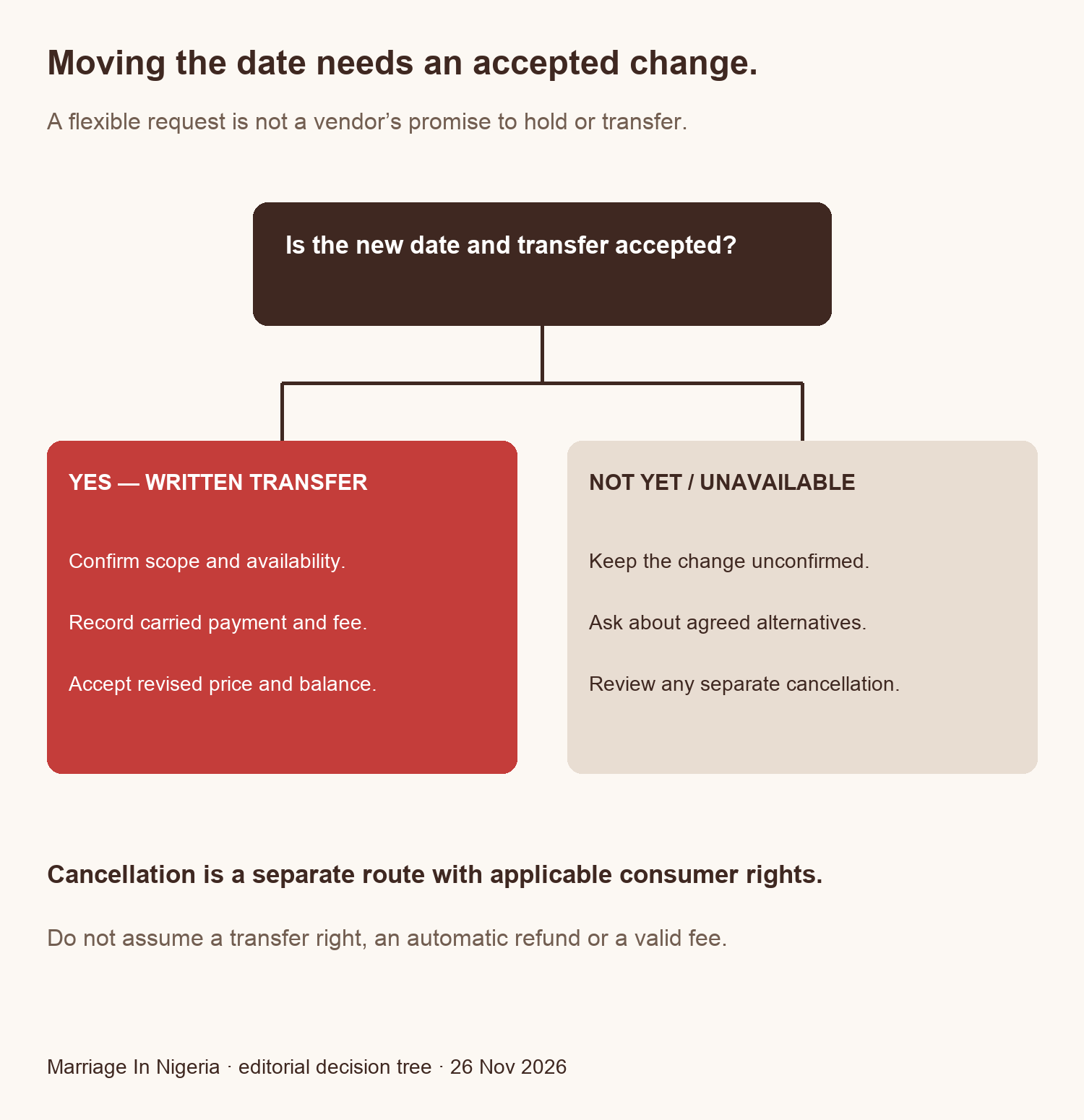
Finally, ask both parties to identify the accepted version. Include the original and new dates, any hold expiry, the amount carried forward, the basis of any fee and the revised balance. Also record the agreed response if the supplier cannot serve the new date. Keep unanswered items visible.
For a disagreement, retain the accepted agreement, receipts, correspondence, dates and the supplier’s explanation. The FCCPC complaint-handling page explains its submission process. This report does not submit a complaint, assess anyone’s eligibility or guarantee a refund or resolution.
Download the written-change and payment tools
Use the fictional calculation and state dictionary to understand the example. Then fill the blank confirmation and payment-reconciliation sheets with actual written terms. They do not accept an agreement on your behalf, determine legal rights or replace professional advice for a specific dispute.
- Fictional date-transfer calculation (CSV)
- Hold, booking, transfer and cancellation dictionary (CSV)
- Blank written date-change confirmation (CSV)
- Blank transfer payment reconciliation (CSV)
Our deposit-confirmation guide addresses verifying payment credit. Our quote-reconciliation guide addresses supplier scope changes. This report instead focuses on moving a date by agreement.
Method and limits: checked on 26 November 2026. Synthetic revised total = 300,000 + 15,000 = 315,000; balance = 315,000 − 100,000 = 215,000. The calculation assumes accepted availability, full credit and no repricing. One request is the fresh editorial lead, not evidence of a completed transfer. One substantive funding chart and a separate decision-tree infographic address the reader’s question without filler figures.
Suggested citation: Marriage In Nigeria, “Wedding Vendor Date Change: Put the Transfer Terms in Writing”, 26 November 2026. Retain the fictional-case and accepted-agreement qualifications with reused figures.