






Wedding vendor arrival planning should start with the moment the family needs the service ready. Reaching a venue gate is only one milestone. Unloading, setup and checks may still lie ahead. Therefore, work backward from a family-approved cue, then ask the supplier to verify the separate travel plan.
Our entirely fictional example starts with an 11:00 cue. Subtract 20 minutes for checks, 40 for setup, 15 for unloading and a 25-minute buffer. The vehicle needs to reach the agreed gate by 09:20 under those assumptions. A chart, two-owner infographic and four CSV tools make the calculation clear without inventing journey times.
Why wedding vendor arrival needs a readiness target
A public traditional-wedding request published on 21 November 2026 asked whether vendors would work outside their usual city. It selected nine services for 100 guests. This shows one stated coordination need, not actual vendor travel, a confirmed booking or evidence of how weddings across Nigeria run.
The current request form provides active service selections and space to explain the brief. Those fields do not establish a supplier’s route, load-in duration or agreed ceremony schedule. Also, we exclude requester names, identifying venue details and contacts from this report and its assets. The example is a separate planning model.
Our wider traditional-wedding protocols guide discusses family coordination and ceremony flow. This report focuses on a narrower question: when must a travelling supplier reach the access point to be ready for an agreed cue? It does not choose the family’s customs or evaluate an MC’s language skills.
Identify the first non-movable cue
First, ask the family’s nominated contact which moment actually requires the vendor’s service. A guest-arrival time, vehicle-arrival time and service-ready time can differ. Record the cue and the people who approve it. Then confirm what “ready” means for the specific supplier’s work.
For example, the family may need a particular service working before a chosen ceremony moment. However, that does not mean every supplier shares one readiness time. Give each relevant role its own target and verification. Do not impose one household’s sequence on another family or community.
Next, agree how the family will communicate a change. Use a named decision-maker and a current version of the schedule. Also identify which choices require family approval and which operational adjustments the planner can make. This prevents a supplier from guessing whether a late arrival changes the ceremony itself.
Work backward through preparation
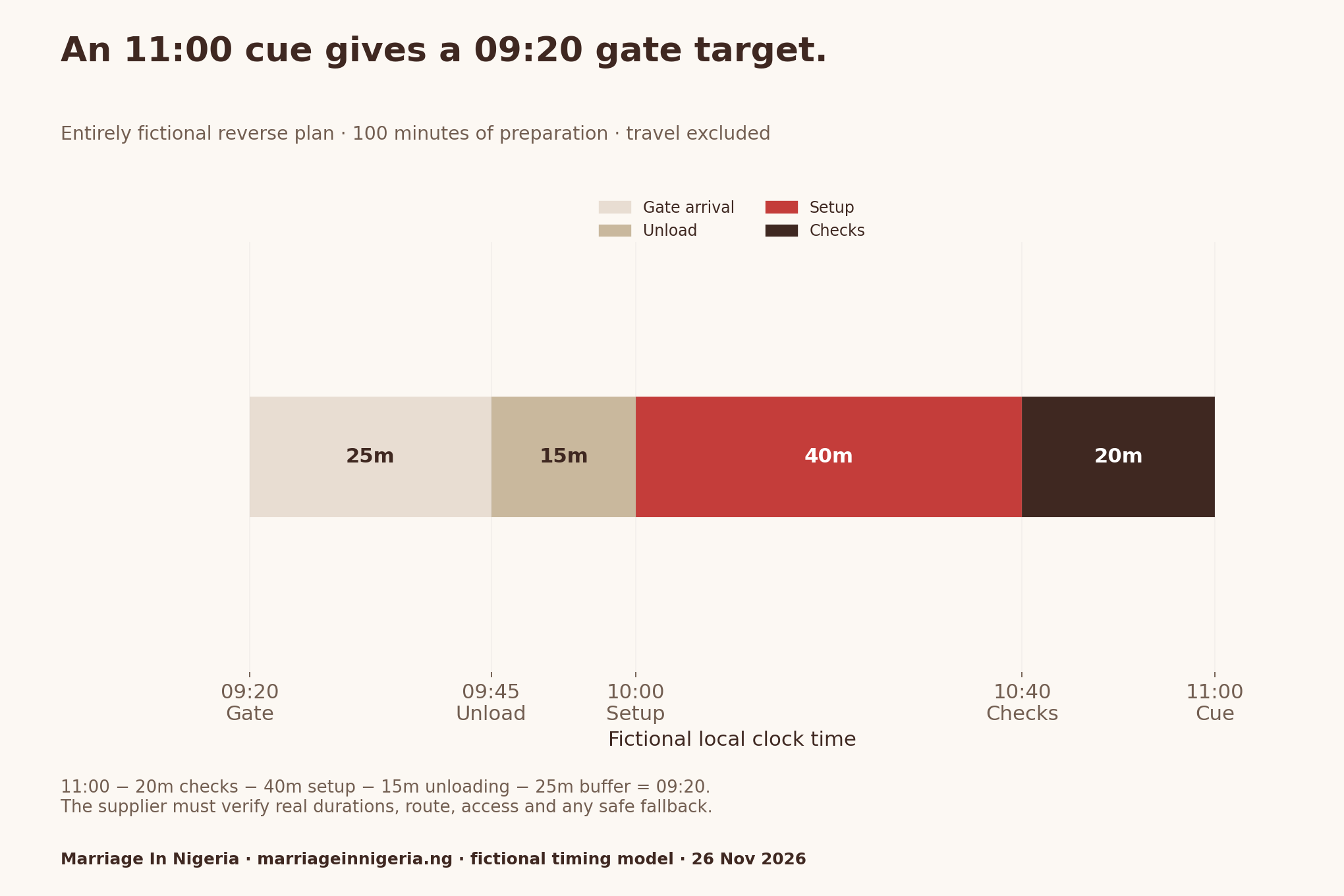
In the fictional model, the cue is 11:00 and checks take 20 minutes. Therefore, checks begin at 10:40. A 40-minute setup starts at 10:00, following 15 minutes of unloading from 09:45. A further 25-minute buffer produces a 09:20 gate-arrival target.
| Fictional stage | Start | Finish | Allowance |
|---|---|---|---|
| Gate arrival and buffer | 09:20 | 09:45 | 25 minutes |
| Unloading | 09:45 | 10:00 | 15 minutes |
| Setup | 10:00 | 10:40 | 40 minutes |
| Checks | 10:40 | 11:00 | 20 minutes |
The arithmetic is 20 + 40 + 15 + 25 = 100 minutes. Subtracting 100 minutes from 11:00 gives 09:20. However, the result works only if the assumed stages, dependencies and access conditions hold. Replace each invented allowance with an agreed duration for the actual job.
If two activities can safely overlap, the vendor must confirm that dependency before you shorten the plan. Conversely, a restricted gate-opening time may make the draft impossible. Keep that conflict visible and agree a revised operational plan rather than hiding it inside the buffer.
Keep route and travel estimates separate
The 09:20 target is not a departure time or a claim about travel between towns. Ask the supplier to verify the route, expected travel conditions and access point. Then agree a departure plan against that information. This report gives no real journey duration and no promise that a route will take a fixed time.
Also confirm parking, unloading space, stairs or restricted access, plus any required venue permission. The supplier can explain what equipment and people must arrive together. Meanwhile, the planner can reconcile the venue’s access window with other suppliers. A map pin alone cannot answer those questions.
Give the family and planner different decisions
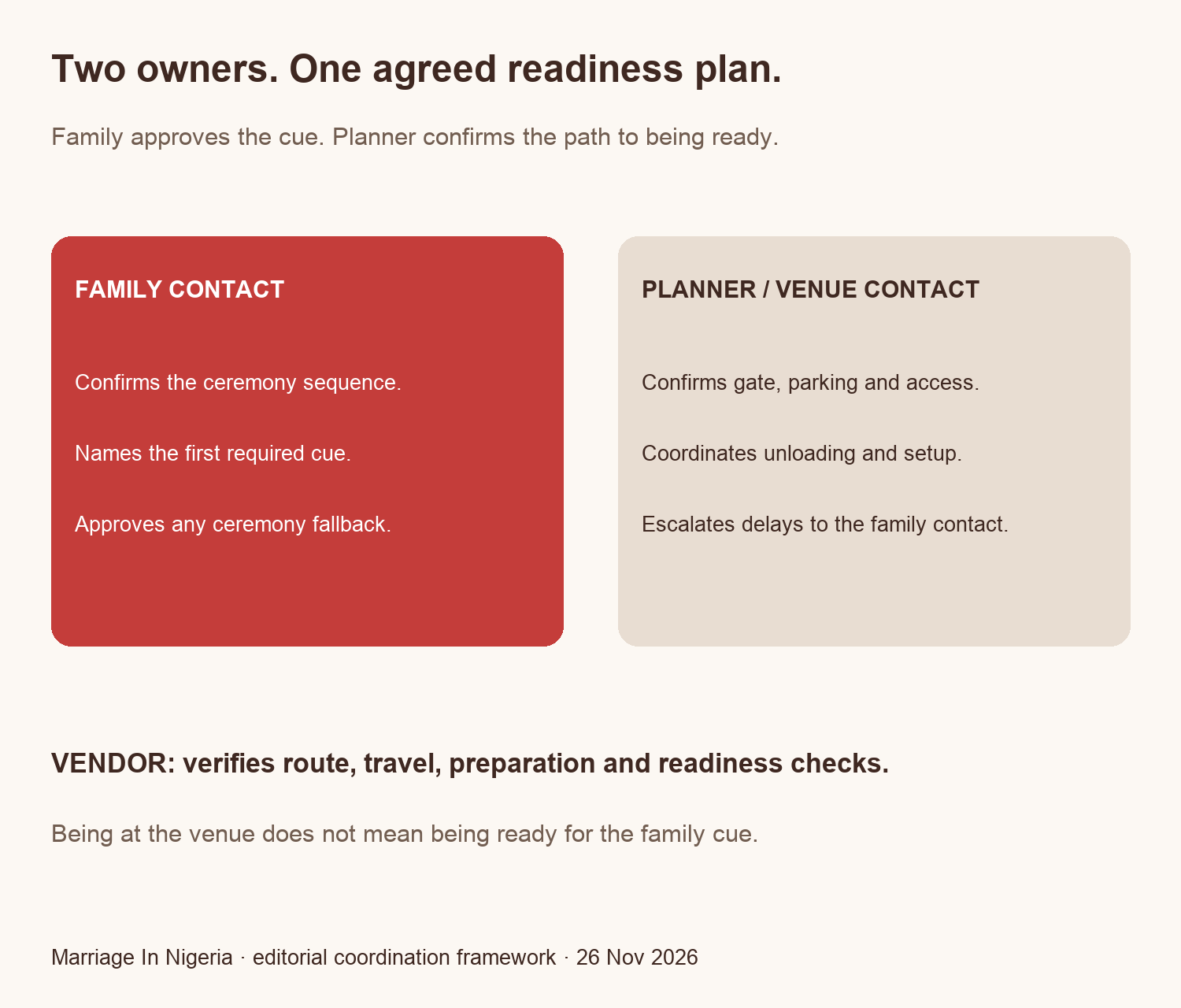
One family contact confirms the ceremony sequence and approves any ceremonial fallback. One planner or venue contact confirms access and coordinates unloading, setup and operational escalation. The vendor verifies the travel and preparation assumptions. Together, they accept one current readiness plan.
If a delay develops, the vendor should report the revised readiness estimate to the agreed contact. Then the family and planner can choose an approved fallback within their responsibilities. Do not assume the vendor can rearrange a ceremony or skip a required check simply because the vehicle is late.
Finally, save the approved timetable, access confirmation and fallback together. Give suppliers the version they need and keep private contact details in the private working plan. For quote responsibilities, our cross-quote reconciliation guide separately explains how to name the owner of each deliverable.
Download the reverse planner and handoff tools
The fictional timeline and measure dictionary reproduce the example. The blank reverse planner leaves travel unknown for provider verification. Use the owner-handoff sheet to record the family, planner and vendor confirmations. No template guarantees arrival, readiness or a particular ceremony outcome.
- Fictional reverse-arrival calculation (CSV)
- Arrival and readiness measure dictionary (CSV)
- Blank vendor reverse-arrival planner (CSV)
- Blank family and planner handoff sheet (CSV)
Method and limits: checked on 26 November 2026. The lead is one public request, not a national dataset. All model durations are fictional and sequential: 11:00 − 100 minutes = 09:20. Travel is excluded and remains unknown. One substantive timeline chart explains this calculation; the separate infographic maps decision ownership. No real travel-time estimate or universal cultural rule is asserted.
Suggested citation: Marriage In Nigeria, “Hometown Wedding Vendor Arrival: Work Backward From the Family Cue”, 26 November 2026. Retain the fictional-duration and travel-excluded qualifications with reused figures.