







Wedding mist fan rental quotes should show more than the amount beside the equipment. A lower final cost can still require more cash before the event. Compare the same fan specification and booked hours, then separate logistics, setup, caution payments and refund conditions.
This guide uses two entirely fictional offers. For example, Offer A needs ₦50,000 upfront and costs ₦40,000 after a full caution refund. Offer B costs ₦44,000 all in with no caution in the example. A is ₦4,000 cheaper after the assumed refund, but requires ₦6,000 more upfront. Two charts, an infographic and four CSV tools make the comparison reproducible.
Why a wedding mist fan rental request needs an itemized quote
A public marketplace request published on 25 November 2026 asked for four mist fans. It is evidence of one stated rental need, not a completed booking, a price paid or a measure of demand across Lagos. We do not reproduce requester names, venue identifiers or contact details in this guide or its downloadable assets.
The current request form treats Rentals as a broad service selection and provides space to explain items and approximate quantities. That broad category does not itself specify fan model, operating hours or package inclusions. Therefore, obtain a written quote that fills those gaps for the actual venue and date.
At our 26 November check, IOR’s mist fan item page displayed ₦7,000. Eloquent’s mist fan page displayed ₦15,000 and advertised delivery and installation. However, those published examples do not establish equivalent date-specific offers. Confirm quantity, period and inclusions directly before comparing totals.
TopRentals’ own terms separately illustrate a refundable caution and logistics calculated for a delivery zone. Those are that provider’s terms, not a rule for every rental vendor. Our invented ₦10,000 caution below is not quoted from TopRentals or applied to either displayed item price.
Compare the same equipment and booked service
Start with fan type, quantity and the hours during which the equipment must be available. Ask whether the charge covers one day, a particular time window or another rental period. Also ask whether the vendor includes setup in that window and when collection must happen.
Then identify delivery, unloading, installation, any required operator and collection. For that reason, compare transport-inclusive offers on the same basis. Ask the supplier to name exclusions and confirm the final scope in writing rather than relying on the word “package”.
Next, get the vendor and venue to agree on suitable placement, water and power arrangements. This article does not prescribe a fan count or promise a cooling result. The four-fan request is a source detail, not a sizing recommendation for your guest count, weather or site.
Two fictional offers, two different totals
In invented Offer A, equipment is ₦28,000, logistics is ₦12,000 and the refundable caution is ₦10,000. The cash required upfront is therefore ₦50,000. If the vendor returns that caution in full and adds no other charges, the final cost is ₦40,000. Offer B is an invented equivalent-scope ₦44,000 all-in offer with no caution.
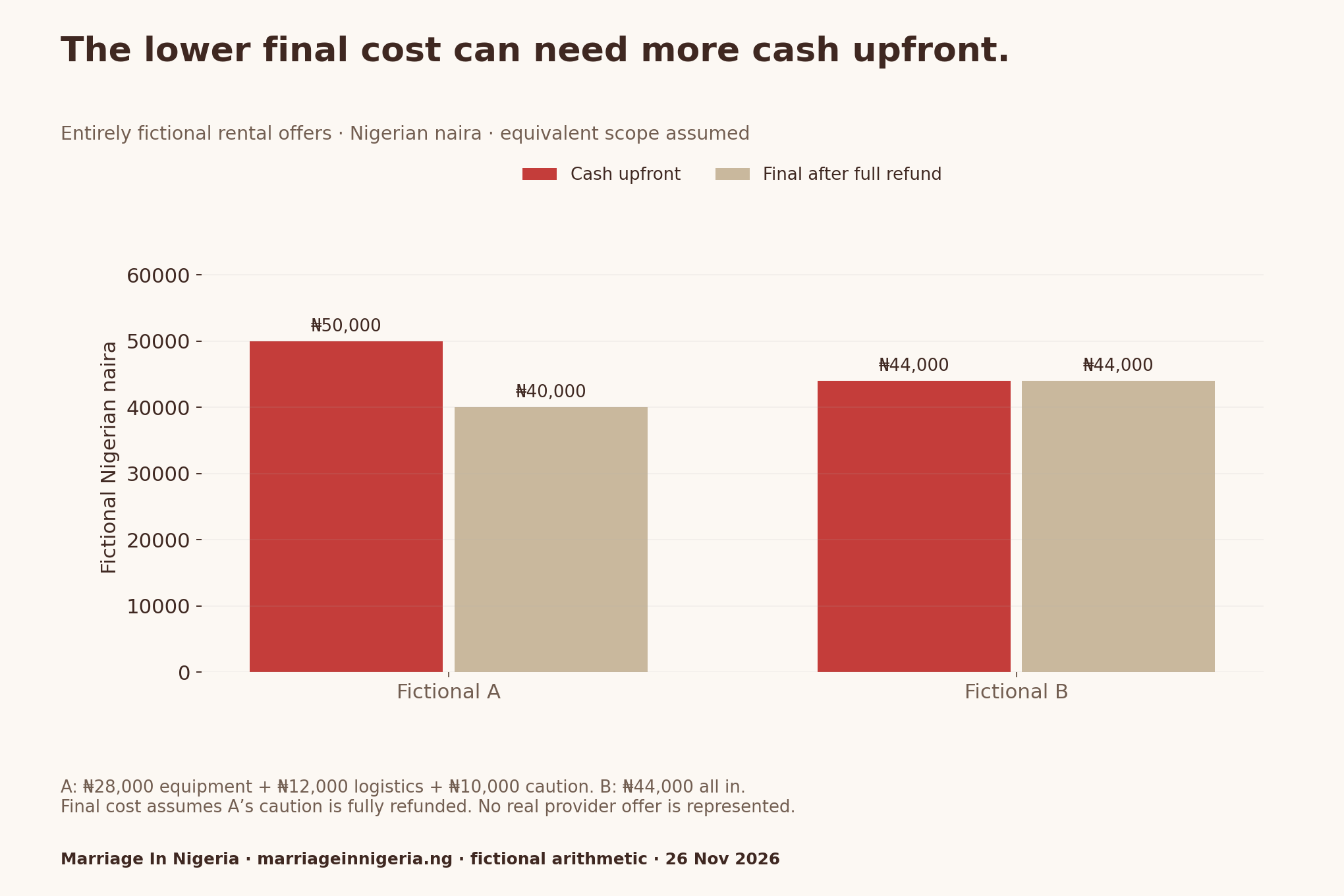
| Fictional measure | Offer A | Offer B |
|---|---|---|
| Equipment and logistics | ₦40,000 | Included in ₦44,000 |
| Refundable caution | ₦10,000 | None assumed |
| Upfront cash | ₦50,000 | ₦44,000 |
| Final cost after full refund | ₦40,000 | ₦44,000 |
As a result, keep both totals in your budget. A lower final cost does not solve a cash shortfall before the event, and a refund due after return cannot fund a payment due earlier. Record the actual payment and refund dates alongside the amounts. The worksheet deliberately leaves those dates blank for vendor confirmation.
Check what happens if some caution is retained
In the same fictional example, A’s final cost is ₦40,000 plus any caution the vendor retains. B remains ₦44,000 under our fixed assumptions. Therefore, they tie if the vendor retains ₦4,000. Above that amount, A’s final cost exceeds B’s. However, if the vendor refunds the whole caution, A keeps its ₦4,000 advantage.
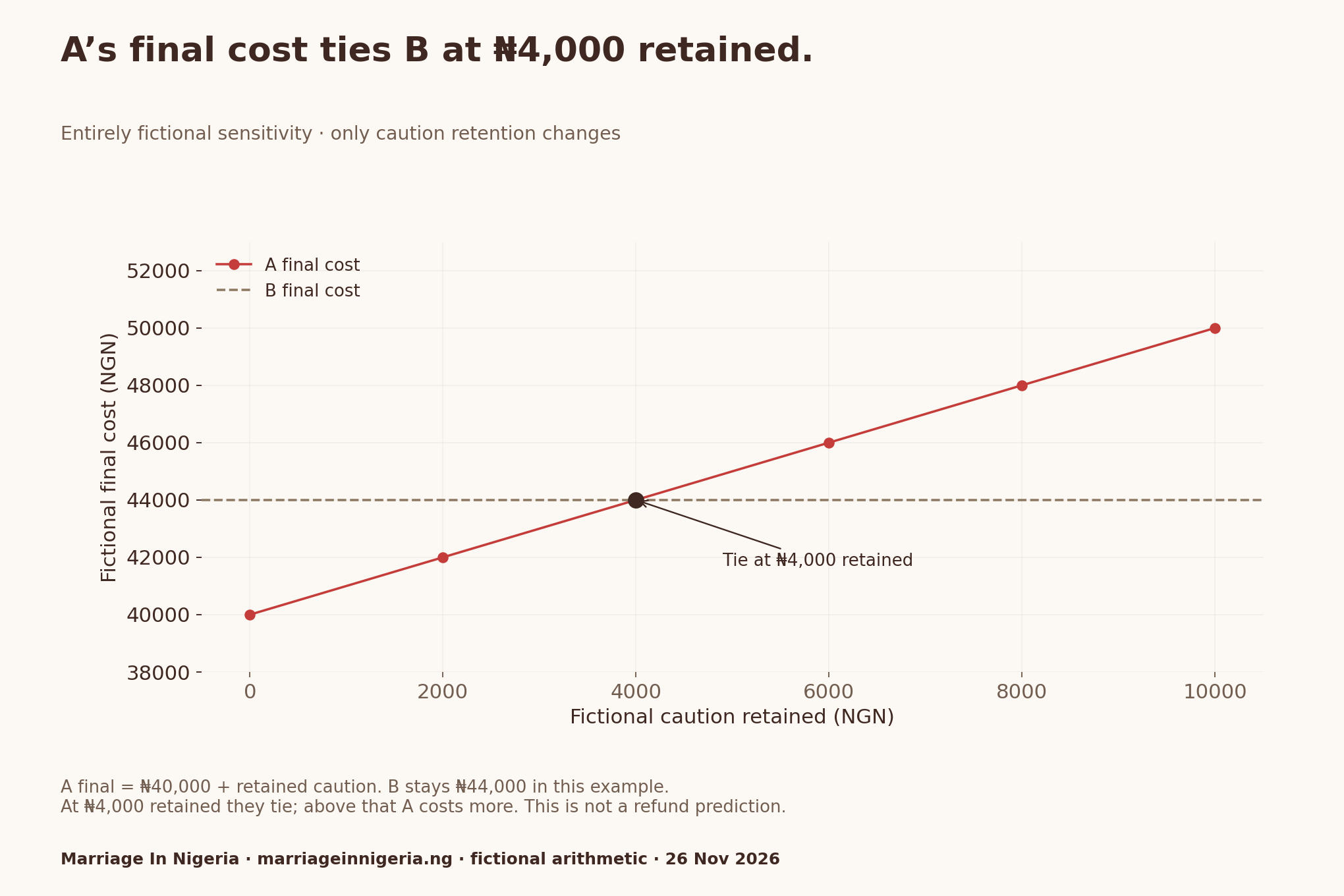
Ask what the caution secures, who checks the equipment after return and how the vendor documents any deduction. Also confirm the refund deadline, recipient and dispute process before paying. Do not assume that a caution is automatically returned immediately, or that every deduction is justified simply because it appears in a message.
Use a two-total quote worksheet
Finally, give each offer its own column, but keep the comparison items identical. Record the equipment, operating period, delivery, setup and collection scope. Add the caution amount, conditions and due dates. Leave unanswered items visible rather than treating a blank field as zero cost or an included service.
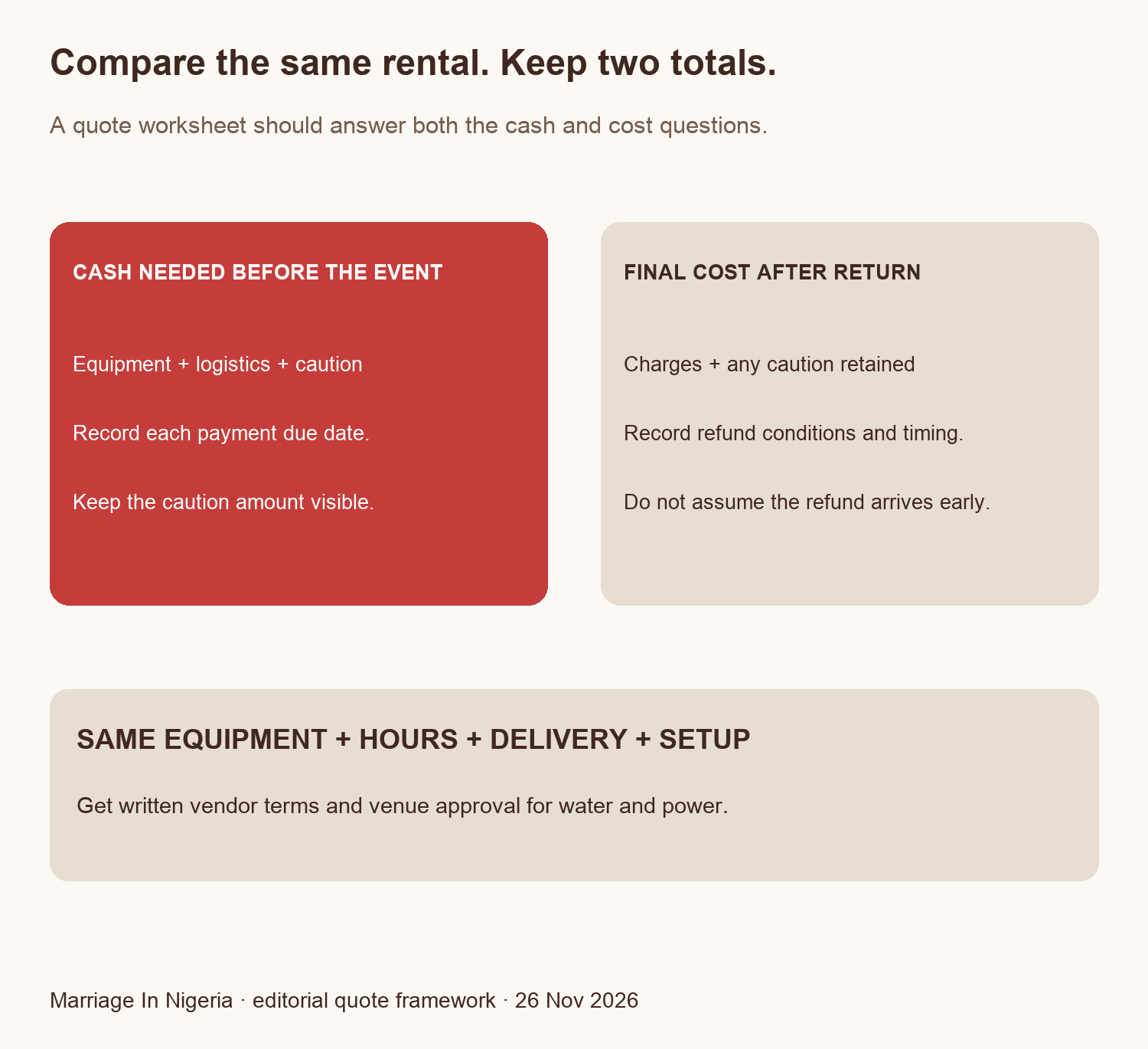
Before accepting, ask the supplier to confirm the complete dated offer and the venue’s requirements. Keep the accepted version, payment schedule and collection conditions together. If a material item changes, compare the revised scope and totals again. An advertised item price is only a starting point for that decision.
Download the comparison data and blank worksheet
The source-scope file preserves the displayed-price limits. The fictional offers and retained-caution scenarios reproduce both charts. Fill the blank quote sheet with actual written terms for your event. None of these tools is a provider endorsement or a forecast of what you will pay.
- Published provider price and scope observations (CSV)
- Fictional two-offer cash and cost comparison (CSV)
- Fictional retained-caution sensitivity (CSV)
- Blank two-column rental quote worksheet (CSV)
Method and limits: sources checked on 26 November 2026. A upfront = 28,000 + 12,000 + 10,000 = 50,000. A final after full refund = 40,000; B = 44,000. The tie is 44,000 − 40,000 = 4,000 retained. These are synthetic offers with equivalent scope assumed. Two substantive charts address cash timing and sensitivity; no market average or fan-sizing claim is made.
For a separate venue decision, see our rain-backup planning guide. For payment records, see confirming a vendor deposit. Suggested citation: Marriage In Nigeria, “Wedding Mist Fan Rental: Compare the Full Quote”, 26 November 2026.


